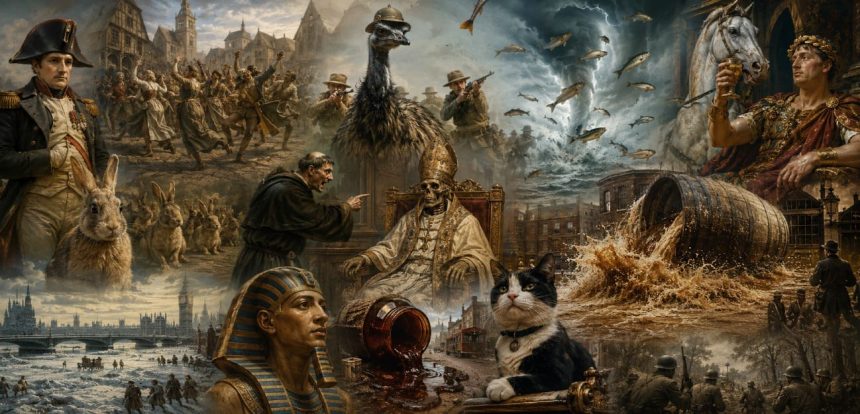
History is often taught as a series of wars, leaders, and major discoveries, but hidden within its timeline are moments so strange and unbelievable that they feel almost fictional. These bizarre historical facts that happened in real life, leaving behind stories that continue to surprise historians and readers alike. From unexpected accidents that changed nations to unusual laws, mysterious events, and shocking human behavior, the past is far more unpredictable than most people imagine. When we look deeper into history, we discover that reality was often stranger, wilder, and more unpredictable than anything written in fiction.
1. The Dancing Plague of 1518
One of the strangest events in recorded history occurred in Strasbourg (modern-day France) when a woman suddenly began dancing in the streets uncontrollably. Within days, dozens joined her. Within weeks, hundreds of people were dancing non-stop—despite exhaustion, injury, and even death. This phenomenon, known as the Dancing Plague of 1518, baffled authorities. Some theories suggest mass hysteria, others blame ergot fungus poisoning, but no explanation has ever been confirmed with certainty. What makes it even more disturbing is that instead of stopping the outbreak, officials reportedly encouraged dancing, thinking it would cure the condition—only making it worse.
2. The Great Emu War
In 1932, Australia found itself in an absurd “war” against emus—large flightless birds. Farmers were struggling as thousands of emus destroyed crops in Western Australia. The government sent soldiers armed with machine guns to control the situation. However, the emus proved surprisingly resilient, fast, and difficult to hit. They scattered in groups, avoided traps, and even outmaneuvered military tactics. Despite firing thousands of rounds, the soldiers failed to eliminate the birds effectively. The result? The emus essentially “won” the war, and the military withdrew in embarrassment.
3. Napoleon Was Once Attacked by Rabbits
Napoleon Bonaparte, the legendary French military leader, once planned a rabbit hunt for his officers. His staff gathered hundreds of rabbits for the event. However, when the cages were opened, instead of fleeing, the rabbits charged toward Napoleon and his men in an overwhelming wave. The animals had become accustomed to being fed by humans and mistook the group for food providers. The army leader who conquered Europe reportedly had to retreat from an army of fluffy rabbits—a bizarre twist in military history.
4. The Time It Rained Fish in Honduras
In the town of Yoro, Honduras, locals claim a phenomenon called “Lluvia de Peces” or “Rain of Fish” occurs almost annually. After heavy storms, the ground is reportedly covered with small live fish. While scientists suggest tornado-like waterspouts may carry fish from nearby waters, the consistency and cultural belief surrounding the event keep it one of the most mysterious natural historical accounts. For locals, it is not just weather—it is tradition, miracle, and history repeating itself in an unbelievable way.
5. The Pope Who Exhumed His Predecessor
In one of the darkest and strangest chapters of church history, Pope Stephen VI ordered the corpse of his predecessor, Pope Formosus, to be dug up and placed on trial. The dead pope was dressed in robes and seated in court while accusations were read against him. Unsurprisingly, the corpse was found “guilty,” and afterward, it was thrown into the river. This horrifying event, known as the Cadaver Synod, shocked medieval society and remains one of the most disturbing political-religious acts ever recorded.
6. The War That Started Over a Stolen Bucket
The “War of the Bucket” between the Italian city-states of Bologna and Modena in 1325 reportedly began when soldiers stole a wooden bucket from a well. What started as a petty insult escalated into a full-scale battle involving thousands of troops. Surprisingly, the bucket itself remains preserved in Modena to this day as a trophy. This conflict highlights how medieval rivalries often turned even the smallest provocations into deadly warfare.
7. A Pope Declared a Corpse Guilty
Following the infamous Cadaver Synod, the dead body of Pope Formosus was not only tried but also “defended” by a deacon assigned to speak on his behalf. The trial was so absurd that it caused outrage across Europe. Eventually, public pressure led to the corpse being retrieved from the river and reburied properly. Later popes even reversed the verdict, declaring the entire event invalid. This bizarre episode shows how political power struggles could reach extreme and irrational lengths.
8. Ancient Romans Used Urine as Mouthwash
In ancient Rome, public urine collection was a common practice because urine contained ammonia, which was used for cleaning. Shockingly, some Romans also used it as a form of mouthwash, believing it whitened teeth and improved oral hygiene. Wealthy citizens even imported urine from specific regions, such as Portugal, which was considered “stronger.” While extremely strange by modern standards, it reflects how ancient societies experimented with chemistry long before modern science existed.
9. The Exploding Whale of Oregon
In 1970, officials in Oregon attempted to remove a dead whale from a beach using dynamite. Their logic was simple: blow it up and let nature handle the rest. Unfortunately, the explosion sent massive chunks of whale blubber flying across the area, damaging cars and terrifying spectators. The event became an infamous example of poorly planned problem-solving and remains a viral piece of historical absurdity even today.
10. The Emperor Who Believed He Was a God… Literally
Several rulers throughout history claimed divine status, but some took it to extreme levels. Roman Emperor Caligula, for example, reportedly demanded to be worshipped as a living god and even planned to make his horse a consul. His reign was marked by eccentric behavior, cruelty, and absolute power taken to madness. Whether all accounts are exaggerated or not, his legacy remains one of the most bizarre examples of leadership in human history.
11. The London Beer Flood of 1814
In 1814, a massive storage vat at the Meux & Co. brewery in London suddenly burst, releasing over 300,000 gallons of beer into the streets. The force of the wave destroyed buildings, flooded homes, and tragically killed several people. Witnesses described it as a “beer tsunami” sweeping through the neighborhood. What makes this event even more bizarre is that it wasn’t initially treated as a major disaster by authorities, despite the chaos it caused. It remains one of the strangest industrial accidents in history.
12. The Pharaoh Who Tried to Erase a God
Ancient Egyptian Pharaoh Akhenaten attempted one of the earliest known religious revolutions by replacing traditional Egyptian gods with the worship of a single deity, Aten. He ordered the removal of other gods’ names from monuments and temples, essentially trying to rewrite spiritual history. After his death, his successors quickly reversed his reforms and erased much of his legacy. The strange part is how completely one ruler tried to reshape an entire civilization’s belief system—and almost succeeded in rewriting history itself.
13. The Year Without a Summer
In 1816, the world experienced a bizarre climate anomaly known as “The Year Without a Summer.” Massive volcanic eruptions—especially Mount Tambora in 1815—caused global temperatures to drop dramatically. Crops failed, famine spread, and snowfall occurred in unexpected months in parts of Europe and North America. Strange weather patterns inspired dark, gloomy literature, including early ideas that influenced Frankenstein. It remains one of the clearest examples of how a single natural event can reshape global history.
14. The Cat That Was Elected Mayor
In the small town of Talkeetna, Alaska, a cat named Stubbs was reportedly made honorary mayor in 1997 and “served” for nearly two decades. While the role was symbolic, Stubbs became a local celebrity, attending meetings, greeting tourists, and even surviving an attack by a dog. The idea of a cat holding political office might sound like a joke, but it became a real and beloved part of the town’s identity.
15. The Poisoned Candy Scare of 1904 Olympics
During the early modern Olympic Games in St. Louis in 1904, marathon runners suffered one of the strangest athletic events in history. Competitors faced dust storms, extreme heat, and even stray dogs. One runner was reportedly poisoned by rotten food along the route but still finished the race. Another participant tried to cheat by riding in a car for part of the marathon. The event was so chaotic it is often remembered as one of the most bizarre Olympic competitions ever held.
16. The Egyptian “Mummy Curse” Panic
When King Tutankhamun’s tomb was discovered in 1922, rumors quickly spread about a “curse” that would kill anyone who entered it. Several people connected to the excavation died within years, fueling global fascination and fear. Newspapers exaggerated the idea, turning it into a sensation. However, most scientists believe the deaths were coincidental. Still, the belief in a cursed tomb became one of the most famous supernatural myths in archaeological history.
17. The Time Paris Became a Giant Refrigerator
During the “Great Frost” of 1709, temperatures in France dropped so severely that wine froze inside bottles and trees cracked from the cold. Rivers froze solid, and entire crops were destroyed. The famine that followed killed hundreds of thousands of people. What makes it bizarre is how quickly a powerful European capital was brought to its knees by nature, turning everyday life into a survival struggle.
18. The Man Who Survived Two Atomic Bombs
Tsutomu Yamaguchi, a Japanese engineer, survived the atomic bombing of Hiroshima on August 6, 1945. He then traveled to his hometown of Nagasaki—only to survive the second atomic bombing three days later. Officially recognized as a survivor of both blasts, his story is one of the rarest and most extraordinary survival accounts in modern history. Despite unimaginable circumstances, he lived for decades afterward.
19. The Real “War of the Stray Dogs”
In 1920s Constantinople (now Istanbul), tensions between authorities and stray dogs reached such a level that thousands of dogs were collected and abandoned on an island. Without food or water, most died, creating a tragic and disturbing episode in urban history. The event caused public outrage and is remembered as one of the most controversial animal control actions ever taken in a major city.
20. The Viking Who Mistook America for Greenland
Long before Columbus, Norse explorers like Leif Erikson reached parts of North America around 1000 AD. However, some sagas suggest confusion and misinterpretation of the lands they discovered, often mixing descriptions of Greenland, Vinland, and unknown territories. This led to centuries of historical misunderstanding about early exploration routes. The idea that early explorers may have “known America” but didn’t fully understand it adds a strange twist to discovery history.
21. The Tulip Mania Crash That Broke an Economy
In the 1630s, the Netherlands experienced one of the most bizarre economic events in history known as Tulip Mania. At its peak, a single tulip bulb could cost more than a house, and people traded land, livestock, and life savings just to own rare flower varieties. The market was driven by speculation and hype rather than real value. Eventually, the bubble collapsed almost overnight, leaving countless people financially ruined. What makes this event so strange is how something as simple as a flower became more valuable than gold before turning worthless in a matter of days.
22. The Great Molasses Flood of Boston
In 1919, Boston experienced an unusual disaster when a massive storage tank filled with molasses suddenly burst. A wave of sticky syrup rushed through the streets at high speed, destroying buildings, toppling trains, and trapping people in thick, sticky liquid. The event killed 21 people and injured many others. Survivors described how the city smelled like molasses for years afterward. The idea of a “sweet disaster” is so unusual that it remains one of the strangest industrial accidents ever recorded.
23. The Defenestration That Started a War
In 1618, in Prague, angry Protestant nobles threw two Catholic officials out of a castle window in an act known as the Defenestration of Prague. Astonishingly, both men survived the fall. However, this bizarre act of political violence sparked the Thirty Years’ War, one of the deadliest conflicts in European history. What began as a symbolic act of throwing people out of a window escalated into a continent-wide war lasting decades, showing how small incidents can trigger massive historical consequences.
24. The Legend of Pope Joan
One of the strangest legends in church history tells of a woman who allegedly disguised herself as a man and became Pope Joan in the Middle Ages. According to the story, her identity was eventually discovered when she gave birth during a procession. While historians debate whether she ever existed, the tale was widely believed for centuries and even influenced church rituals. Whether myth or misunderstanding, the idea that a woman could secretly become pope adds a bizarre twist to medieval history.
25. The Great London Smog “The Great Stink”
In 1858, London suffered from an overwhelming pollution crisis known as The Great Stink. Hot weather caused untreated sewage in the River Thames to produce an unbearable smell that spread across the entire city, including Parliament. The stench became so strong that officials had to drench curtains in chemicals just to continue working. This bizarre environmental disaster directly led to the modernization of London’s sewage system, proving that even foul smells can change public infrastructure forever.
26. Japan’s Hidden Christian Communities
After Christianity was banned in Japan in the 17th century, thousands of believers went underground to avoid persecution. These “Hidden Christians” maintained their faith in secret for centuries, blending religious practices with local traditions to avoid detection. When Japan reopened to the world in the 1800s, some communities were discovered still practicing modified versions of Christianity after more than 200 years of isolation. This long-hidden survival of belief is one of the most unusual religious histories ever recorded.
27. Emperor Norton I of the United States
In the 1800s, a man named Joshua Norton declared himself “Emperor of the United States” and later “Protector of Mexico.” Surprisingly, instead of being dismissed entirely, the citizens of San Francisco embraced him as a local celebrity. He issued fake decrees, wore military-style uniforms, and even had currency printed in his name, which some businesses accepted for fun. Emperor Norton I never held real political power, but he became a beloved figure in American folklore.
28. The CIA’s Strange Assassination Attempts
During the Cold War, reports suggest that intelligence agencies explored some highly unusual assassination methods, including exploding cigars, poisoned pens, and other covert gadgets aimed at political targets. While many of these plans were never fully executed or remain unverified, they reflect the extreme creativity of espionage tactics during the era. The idea of everyday objects being turned into weapons adds a surreal layer to real-world geopolitical tension.
29. The Defeat of a Superpower by a Small Island (Emu-Level Humiliation Revisited)
In several historical accounts of colonial conflicts, smaller, poorly equipped groups have unexpectedly resisted or delayed major powers using terrain knowledge and guerrilla tactics. One symbolic example is how advanced military forces often underestimated local resistance, leading to prolonged conflicts they did not anticipate. These moments reveal how strategy, environment, and determination can sometimes outweigh technological superiority, reshaping the outcome of seemingly one-sided confrontations.
30. The Korean Axe Murder Incident That Almost Sparked War
In 1976, a seemingly simple task of trimming a tree in the Korean Demilitarized Zone escalated into a deadly confrontation between North Korean soldiers and United Nations forces. Two U.S. officers were killed during the incident, leading to Operation Paul Bunyan, a massive show of military force involving helicopters, troops, and heavy equipment sent to cut down the same tree. What began as a landscaping dispute nearly escalated into a major international conflict, making it one of the most bizarre near-war incidents of the 20th century.