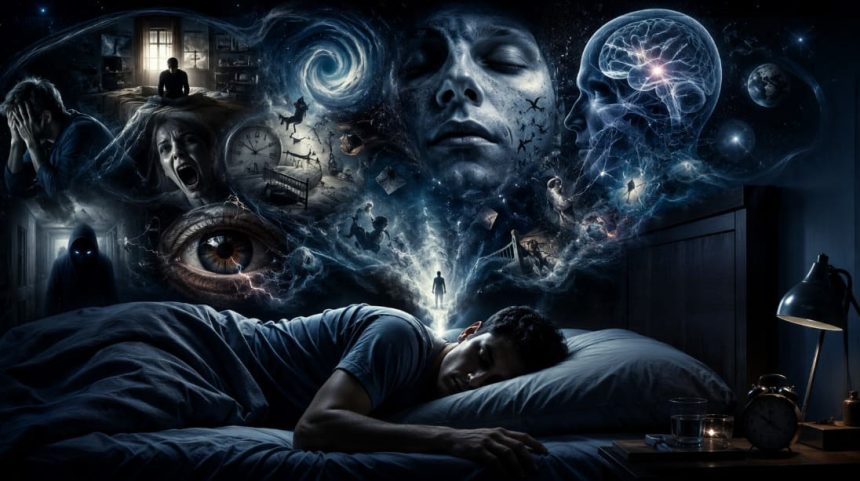
Sleep is supposed to be peaceful, restorative, and essential for survival—but hidden beneath the surface are terrifying realities that most people never think about. Scientists have uncovered shocking truths about nightmares, sleep paralysis, hallucinations, and the strange ways the brain behaves while unconscious. These Most Disturbing Sleep Facts about sleep reveal that the sleeping mind can become unpredictable, mysterious, and sometimes deeply unsettling. From people acting out dreams to rare conditions that prevent sleep entirely, the world of sleep contains secrets far darker than most imagine.
1. Your body becomes completely “locked” while your mind stays active
Every night during REM sleep, your brain triggers a biological shutdown of most voluntary muscles. This state, known as REM atonia, prevents you from physically acting out your dreams. It is essentially a built-in paralysis that keeps you safe while your mind runs simulations of impossible worlds. What makes this disturbing is the separation it creates: your consciousness can be running through vivid, emotional, and sometimes violent dream scenarios, while your body lies completely motionless and unresponsive. In rare cases, if this system fails, people can physically act out dreams without awareness, revealing how dependent your safety is on a mechanism you never consciously control.
2. Dreams can replicate reality so perfectly your brain cannot tell the difference
When you dream, your brain activates many of the same regions used during waking perception. This means you don’t just “see” dreams—you experience them as fully immersive realities. You can feel textures, hear voices, sense movement, and even experience fear or pain as if it were real. In that moment, your brain does not label the experience as fake. To your sleeping mind, the dream is reality. The disturbing implication is that your sense of reality is not fixed—it is something your brain constructs, and during sleep, it can construct an entirely different world that feels just as valid as waking life.
3. You repeatedly wake up every night without realizing it
Sleep is not a smooth, uninterrupted state. Throughout the night, your brain shifts between cycles of deep sleep and brief awakenings. These micro-awakenings can happen dozens or even hundreds of times, but they are so short that you never consciously remember them. This creates the illusion of continuous sleep, even though your brain is constantly switching between states. The unsettling part is that your experience of “sleeping through the night” is partly a memory illusion—your mind edits out these interruptions so you believe you rested continuously.
4. Sleep paralysis can trap your awareness inside a motionless body
One of the most disturbing sleep experiences occurs when consciousness wakes before the body does. In sleep paralysis, your mind becomes aware while your body remains in REM atonia, unable to move or speak. This creates a terrifying disconnect between thought and action. Many people also experience vivid hallucinations during this state, often involving a presence in the room or pressure on the chest. The horror comes from helpless awareness—you are fully conscious, yet completely unable to respond, as your brain finishes shutting down the body’s dream-state protections.
5. Your brain deletes most dreams within minutes of waking
Even the most vivid and emotionally intense dreams are usually erased almost immediately after you wake up. Within a few minutes, up to 90% of dream content is lost. This is because the brain does not store most dreams as long-term memories unless they are strongly reinforced. The disturbing consequence is that you may experience entire worlds, conversations, and emotional events every night that vanish completely, leaving no trace that they ever existed. Your nights are filled with experiences your waking self will never know happened.
6. Dreams can corrupt and rewrite real memories
During sleep, your brain actively processes and reorganizes memory. While this is important for learning and emotional balance, it also allows dream content to merge with real experiences. Over time, fragments of dreams can become blended with actual memories, creating false recollections that feel completely real. You might remember conversations that never happened or events that were only dreamed. The unsettling truth is that memory is not a perfect recording—it is constantly edited, and sleep is one of the main editing processes.
7. Your body can perform complex actions without your awareness
In certain sleep disorders or partial arousal states, the brain fails to fully enforce muscle paralysis during REM sleep. This can lead to sleepwalking, sleep talking, or even more complex behaviors like opening doors or moving objects—all while the person remains completely unconscious. The disturbing part is that these actions can appear intentional from the outside, yet there is no conscious control or awareness behind them. It reveals that movement and decision-making can occur without the presence of conscious thought.
8. Your brain never stops monitoring the world around you
Even in deep sleep, your auditory system and certain brain regions remain partially active. This allows your brain to detect changes in the environment, such as loud noises or potential threats, and wake you if necessary. It means sleep is not true disconnection from reality, but a carefully controlled reduction of awareness. The unsettling aspect is that your brain never fully “lets go”—it stays partially alert, as if guarding you from the world even when you are unconscious.
9. Time inside dreams is completely distorted and unreliable
Your brain does not process time the same way during sleep as it does while awake. A dream that feels like hours, days, or even an entire lifetime may occur in just a few minutes of real time. This happens because dream experiences are constructed rather than continuously lived moment by moment. The disturbing implication is that your perception of time is not stable—it is generated by your brain, and during sleep, that system can be completely rewritten, creating lifelike experiences in compressed moments.
10. Emotional experiences in dreams can feel more intense than real life
Dreams are not emotionally muted—they can be extremely powerful. Fear, love, sadness, and joy can feel amplified because the brain activates emotional centers without the balancing influence of logic or reality-checking systems. This can make dream emotions feel overwhelming and deeply real, sometimes lingering after waking. You might wake up shaken, joyful, or distressed without understanding why. The disturbing part is that your emotional state can be shaped by experiences that never actually happened, yet still affect your waking mind.
11. Your brain never truly “turns off” even in deep sleep
Even when you are in the deepest stages of sleep, your brain is still quietly active in the background. It continues monitoring sound, scanning for danger, and maintaining basic awareness of the environment. This means sleep is not a complete shutdown, but a carefully regulated state of partial consciousness. The disturbing part is that you are never fully gone—you exist in a reduced, controlled version of awareness that keeps running even when you feel completely unconscious.
12. You can experience terrifying dreams without any memory of them
Not all dreams survive into waking memory. In fact, most emotionally intense or disturbing dreams are erased almost immediately after waking. This means you may experience fear, panic, or distress during the night and never consciously remember it. Yet your body and mood can still carry the emotional residue into the next day. The unsettling idea is that your mind can be affected by experiences you will never be able to recall.
13. Sleep paralysis exposes the split between mind and body
Sleep paralysis occurs when your consciousness wakes up while your body remains in REM muscle shutdown. You are aware, thinking, and fully conscious—but completely unable to move or speak. This disconnect can last seconds or even minutes and is often paired with hallucinations that feel extremely real. The disturbing aspect is the helpless awareness: your mind is awake, but your body is still trapped in sleep mode, unable to respond to anything.
14. Dreams can feel like entire lifetimes compressed into minutes
During REM sleep, your brain constructs experiences without following real-world time rules. A dream may feel like it lasts hours, days, or even years, while in reality only a few minutes have passed. Your brain compresses complex narratives into short bursts of neural activity. The unsettling implication is that your perception of a “life experience” can be artificially generated in moments, meaning time inside your mind is completely flexible and unreliable.
15. Your brain can simulate pain and physical injury in dreams
Dreams are not limited to images and thoughts—they can include intense physical sensations. Your brain can generate feelings of pain, pressure, burning, or movement so realistic that your body reacts as if they are real. Some people wake up physically tense, sore, or emotionally shaken after dream experiences that never actually happened. This shows how easily the brain can create a full sensory world that your body believes without question.
16. Your identity becomes unstable and changeable while dreaming
During deep REM sleep, your sense of identity can dissolve completely. You may not recognize yourself, your life, or your real-world personality while dreaming. Instead, your brain constructs temporary versions of “you” that behave differently in each scenario. The disturbing part is that your identity is not fixed at all times—it can be paused, rewritten, or replaced every night without your awareness.
17. Severe sleep deprivation can break reality perception
When the brain is deprived of sleep for extended periods, it begins to malfunction. People may experience hallucinations, paranoia, and distorted thinking similar to psychosis. Even short-term sleep loss can affect emotional control and decision-making. The unsettling truth is how quickly this can happen—your grip on reality depends heavily on consistent sleep, and without it, perception itself begins to collapse.
18. Your brain performs self-cleaning while consciousness is suspended
During deep sleep, the brain activates a system that removes toxins and waste products built up during waking hours. This cleaning process requires changes in blood flow and neural activity that reduce conscious awareness. In other words, your mind must partially shut down so your brain can physically maintain itself. The disturbing idea is that consciousness is not permanent—it is periodically suspended so your brain can survive.
19. You can wake up with completely changed emotions
Sleep plays a major role in emotional processing, but it often removes the original cause of those emotions. As a result, you may wake up feeling anxious, calm, sad, or emotionally different without any clear reason. Your brain has already adjusted emotional responses overnight, but the explanation behind them is gone. This creates a strange disconnect where your feelings are real, but their origins are completely hidden from you.
20. Different parts of your brain can operate independently during sleep
In certain sleep states, the brain does not function as a fully unified system. Instead, different regions can become active or inactive independently, leading to behaviors like sleepwalking, sleep talking, or automatic actions performed without awareness. This reveals a disturbing truth: your conscious self is not always in control. During sleep, parts of your brain can temporarily take over, running processes and behaviors without “you” being involved at all.
21. Your brain can create false awakenings that feel completely real
Sometimes, you “wake up” inside a dream and believe you are conscious in your real room, only to realize later that you are still asleep. These false awakenings can repeat multiple times in a chain, making it feel like you are trapped in layers of reality. The disturbing part is how convincing they are—your brain can perfectly simulate waking life, down to your surroundings, thoughts, and routine, blurring the line between reality and illusion.
22. You are more vulnerable to emotional trauma during sleep
During REM sleep, your brain processes emotional memories without the logical filtering systems that exist when you are awake. This means fear, sadness, or stress can be reprocessed in a raw, amplified form. The unsettling implication is that your brain revisits emotional experiences every night, sometimes intensifying them without your conscious control, reshaping how you feel about past events without your awareness.
23. Your brain can generate voices and conversations from nothing
Auditory hallucinations are common in certain sleep states, especially during falling asleep or waking up. Your brain can create realistic voices, conversations, or sounds that feel completely external. These hallucinations can be so vivid that they seem like someone is actually in the room speaking. The disturbing part is that your brain can fully simulate external reality, making it nearly impossible to immediately distinguish between real and imagined sound.
24. Sleep can fragment your sense of continuous identity
Each sleep cycle slightly resets your brain’s awareness, meaning your sense of “continuous self” is reconstructed every morning. You are not a single uninterrupted stream of consciousness—you are repeatedly paused and rebuilt. The unsettling idea is that the “you” who goes to sleep and the “you” who wakes up are not perfectly continuous, but versions of the same mind stitched together by memory.
25. Your brain can suppress reality checks during dreams
In normal waking life, your brain constantly verifies reality through logic and sensory consistency. During dreams, this system is largely отключed, allowing impossible events to feel normal. You can accept absurd situations without question. The disturbing implication is that your sense of reality depends on a system that is actively turned off every night, leaving you unable to recognize falsehood while dreaming.
26. Chronic poor sleep can permanently alter brain function
Long-term sleep deprivation does not just cause temporary fatigue—it can change how the brain functions. Memory, emotional regulation, and decision-making pathways can become impaired over time. The unsettling part is that damage from repeated poor sleep can accumulate silently, meaning your brain may gradually lose efficiency without any obvious warning until problems become noticeable.
27. You may physically react to dream stress while asleep
Even though your body is mostly paralyzed during REM sleep, your autonomic nervous system remains active. This means your heart rate, breathing, and stress hormones can spike during intense dreams. You might be experiencing fear or panic in your sleep while your conscious mind is completely unaware. The disturbing truth is that your body can go through extreme emotional states while you are not mentally present.
28. Sleep can erase or weaken emotional memories over time
During sleep, the brain selectively processes memories, often reducing the emotional intensity of experiences. While this is helpful for healing, it also means emotional connections to real-life events can fade or shift without conscious input. The unsettling part is that your emotional memory is constantly being edited overnight, changing how you feel about past experiences without your direct control.
29. You can enter dream loops that feel inescapable
Some people experience repetitive dream cycles where they relive similar scenarios multiple times within a single sleep session. These loops can feel like being stuck in an endless cycle of waking, realizing, and re-entering dreams. The disturbing aspect is the loss of control—you cannot force your mind out of the loop because you are fully inside it, without awareness of how to escape.
30. Your perception of reality depends on sleep more than you realize
Sleep is not just rest—it is essential for maintaining a stable sense of reality. Without it, perception, memory, emotion, and awareness begin to break down. The most unsettling fact is that your waking life depends on a process you are completely unconscious during. Every sense of stability, identity, and clarity is rebuilt nightly while you are not aware, meaning your reality is continuously maintained by something you cannot control or observe.