Sleep is often seen as a peaceful escape from reality, a time when the body heals and the mind resets. But beneath this calm surface lies a world of unsettling biological processes, strange brain behavior, and hidden dangers that most people never think about. From the terrifying nature of sleep paralysis to the disturbing truth about how little sleep deprivation it takes to affect your sanity, sleep is far more complex—and disturbing—than it appears. What follows are some of the most shocking discoveries scientists have made about what really happens when we close our eyes at night. Here’s The Most Disturbing Facts Ever Discovered About Sleep.
1. Your Brain Never Truly Sleeps
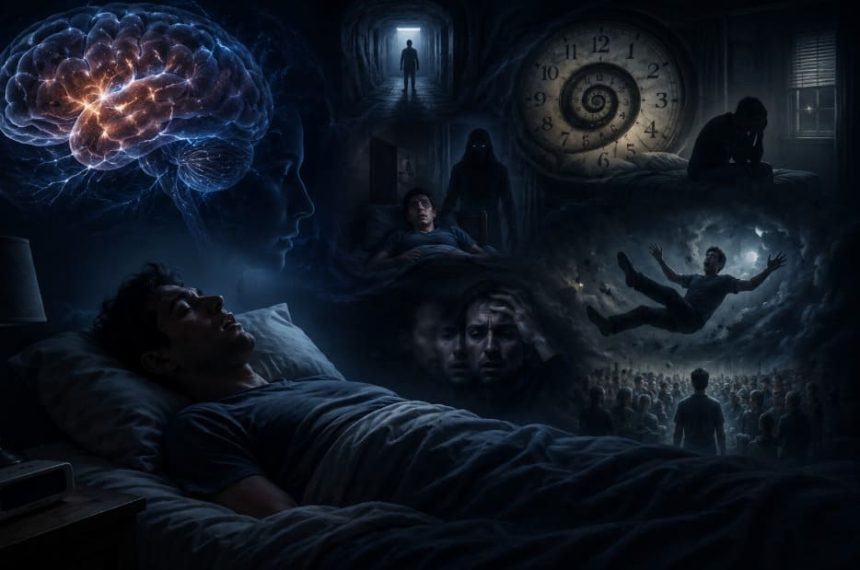
Even when your body appears completely at rest, your brain is far from inactive. During different sleep stages, especially REM (Rapid Eye Movement) sleep, the brain becomes highly energetic, sometimes even more active than when you are awake. It processes memories, emotions, and sensory information while creating vivid dream scenarios that feel completely real in the moment. What makes this truly disturbing is that your brain is essentially running a simulation of reality every night without your conscious control. Faces you have never seen, places you have never visited, and events that defy logic are all generated internally by fragments of memory and imagination. In a sense, you are experiencing a parallel reality every night, one that feels authentic while it lasts, yet is entirely constructed by your own mind.
2. Sleep Paralysis: Conscious but Trapped
Sleep paralysis is one of the most terrifying experiences the human brain can produce. It occurs when your mind wakes up before your body has finished transitioning out of REM sleep, leaving you fully aware but unable to move or speak. During this state, the brain can still generate dream-like hallucinations, which often blend with reality. People commonly report sensing a presence in the room, hearing footsteps, or seeing dark figures standing nearby. Some even feel pressure on their chest, as if something is holding them down. Although science explains it as a temporary disconnect between brain and muscle control systems, the experience feels deeply real and often traumatic, leaving lasting fear even after waking completely.
3. Chronic Sleep Deprivation Can Alter Your Personality
Lack of sleep does far more than cause fatigue—it can fundamentally change how a person thinks, feels, and behaves. When the brain is consistently deprived of rest, emotional regulation weakens, leading to heightened irritability, anxiety, and impulsive reactions. Over time, this can shift a person’s personality, making them more emotionally unstable or detached from rational thinking. In severe cases, prolonged sleep deprivation can even trigger hallucinations and paranoia, mimicking symptoms of serious mental disorders. The most unsettling part is how gradually this transformation happens; a person may not notice their own decline until their behavior has already significantly changed.
4. You Can Forget How Tired You Are
One of the most dangerous effects of sleep deprivation is the brain’s ability to normalize exhaustion. As sleep loss continues, cognitive function declines, yet subjective awareness of tiredness does not always increase. This creates a false sense of functioning normally, even when reaction times, decision-making, and attention are severely impaired. The brain essentially adjusts to the new state and tricks you into believing you are fine. This is particularly dangerous because individuals may continue driving, working, or making important decisions without realizing how compromised their mental performance has become.
5. Your Brain Literally Cleans Itself While You Sleep
During deep sleep, the brain activates a specialized system known as the glymphatic system, which functions like a waste removal network. It clears out toxins, metabolic byproducts, and proteins that accumulate during waking hours. This process is essential for maintaining long-term brain health and cognitive performance. When sleep is consistently disrupted or insufficient, this cleaning process becomes less effective, allowing waste materials to build up. Over time, this has been linked to serious neurological risks, including memory decline and increased vulnerability to degenerative conditions. The disturbing implication is that poor sleep doesn’t just affect tomorrow—it may quietly damage your brain over years.
6. Dreams Can Be Emotionally Realistic
Dreams are not just visual stories; they are deeply emotional experiences that can affect your mood long after you wake up. During REM sleep, the brain activates emotional centers while reducing logical reasoning, which is why dream scenarios can feel so intense and believable. Love, fear, grief, and joy experienced in dreams can trigger real physiological responses, including increased heart rate and stress hormones. Even though the events are not real, the emotional impact is genuine, sometimes leaving lingering feelings of sadness, anxiety, or happiness after waking. This blurring of emotional boundaries between dream and reality can make the mind feel vulnerable and unsettled.
7. Micro-Sleeps Can Happen Without Warning
When the brain becomes severely sleep-deprived, it may enter brief, uncontrollable shutdowns known as micro-sleeps. These episodes last only a few seconds but involve complete loss of awareness, even if the person’s eyes remain open. During a micro-sleep, the brain temporarily disengages from reality, essentially “disconnecting” without warning. The person may not even realize it has happened, which makes it extremely dangerous in situations requiring attention, such as driving or operating machinery. The most disturbing aspect is that the body can appear awake while the mind is momentarily absent, creating a hidden but serious risk.
8. Some People Act Out Their Dreams
In certain sleep disorders, the natural paralysis that protects the body during REM sleep fails to activate properly. This condition allows individuals to physically act out their dreams, sometimes in aggressive or dangerous ways. Known as REM sleep behavior disorder, it can cause people to shout, kick, punch, or even jump out of bed while still dreaming. What makes this especially unsettling is that the person has no awareness or control over these actions, as they are fully immersed in the dream world. In some cases, dream scenarios involving fear or threat can translate into real physical movements, posing risks to both the individual and those nearby.
9. Sleep Loss Affects Memory Formation
Sleep plays a critical role in how the brain processes and stores memories. During sleep, especially deep stages, the brain organizes and transfers short-term memories into long-term storage. When sleep is disrupted, this process becomes incomplete, leading to forgetfulness and difficulty learning new information. Even more concerning, fragmented sleep can distort memory accuracy, causing the brain to misfile or alter details of past experiences. This means that lack of sleep does not just weaken memory—it can actively change how events are remembered, creating confusion between what actually happened and what the brain thinks happened.
10. The Brain Can Create False Awakening Dreams
False awakening dreams are one of the most confusing sleep experiences a person can have. In this state, you dream that you have woken up and started your normal daily routine, often performing familiar actions like brushing your teeth, checking your phone, or preparing for the day. Everything feels completely real, including the environment and your sense of awareness. However, you are still dreaming. In some cases, multiple layers of false awakenings can occur, where you believe you have woken up repeatedly only to remain in the dream state. This creates a disturbing loop that blurs the boundary between sleep and reality, making it difficult to trust your own perception even after you finally wake up.
11. Sleep Can Distort Time Perception
One of the most unsettling aspects of sleep is how it warps your sense of time. In dreams, minutes can feel like hours, and entire lifetimes can seem to pass within a single night. Your brain does not follow real-world time rules during sleep; instead, it stitches events together based on emotional intensity and narrative flow. This distortion becomes disturbing when you realize that your mind can create an entire “lifetime experience” in a short REM cycle. When you wake up, you may feel like you have lived through something extensive and meaningful, even though only minutes of actual brain activity produced it. This manipulation of time perception shows how fragile your awareness of reality truly is during sleep.
12. You Can Experience Pain in Dreams
Dreams are not limited to visuals and emotions—they can also include physical sensations, including pain. The brain is capable of simulating pain signals during sleep, making dream experiences feel physically real. A person might feel like they are being injured, falling, or trapped, and those sensations can be intensely vivid. What makes this disturbing is that the pain is not imaginary in feeling; it triggers real neural pathways similar to actual physical injury. Even after waking, the emotional residue of dream pain can linger, leaving the body tense or uneasy despite no real harm occurring.
13. Sleep Deprivation Weakens Reality Testing
When the brain is deprived of sleep, its ability to distinguish between real and unreal experiences begins to break down. This function, known as reality testing, is crucial for logical thinking and perception. Without proper sleep, the mind becomes more suggestible and prone to misinterpretation. People may start seeing patterns that aren’t there, hearing sounds incorrectly, or believing irrational thoughts. In extreme cases, prolonged deprivation can lead to hallucinations that feel completely real. The disturbing part is how gradually this breakdown occurs—reality itself becomes less stable without enough rest.
14. The Brain May “Replay” Trauma During Sleep
During REM sleep, the brain processes emotional memories, including traumatic experiences. However, instead of healing, this process can sometimes replay distressing events in vivid detail. This is especially common in conditions like PTSD, where nightmares repeatedly reconstruct traumatic moments. These dream replays are not passive—they often carry the same emotional intensity as the original experience. This means sleep, which is supposed to be restorative, can instead become a space where emotional wounds are relived again and again, preventing full psychological recovery.
15. Sleep Talking Can Reveal Hidden Thoughts
Sleep talking, or somniloquy, occurs when the brain partially activates speech centers during sleep. People may speak clearly, whisper, or even shout phrases without any awareness. The content can range from random words to emotionally charged statements that seem unrelated to waking behavior. What makes this disturbing is that it suggests the brain can bypass conscious filters during sleep, potentially exposing thoughts or emotions a person is not aware of while awake. Although not always meaningful, it highlights how loosely controlled the mind becomes in unconscious states.
16. Some People Experience Sleepwalking Complexity
Sleepwalking is not just simple walking—it can involve complex behaviors such as eating, opening doors, or even attempting to drive. During these episodes, the brain is in a mixed state where parts controlling movement are active, while conscious awareness remains asleep. The person has no memory of these actions afterward. The disturbing aspect is the level of coordination possible without awareness, meaning the body can perform surprisingly complex tasks while the mind is completely disconnected from reality.
17. Your Body Becomes Partially Immune-Compromised
Lack of sleep weakens the immune system significantly. During deep sleep, the body produces cytokines—proteins that help fight infection and inflammation. When sleep is reduced, this production decreases, leaving the body more vulnerable to illness. Over time, chronic sleep deprivation can make even minor infections harder to fight off. The disturbing truth is that something as simple as staying awake too long can quietly reduce your body’s natural defense system without immediate warning signs.
18. Dreams Can Blend With Real Memories
Sometimes the brain confuses dream content with real experiences, especially when dreams are vivid or emotionally strong. This can lead to false memory formation, where a person believes something happened in real life when it actually occurred in a dream. The disturbing part is that memory itself becomes unreliable, as the brain does not always label experiences as “dream” or “real” clearly. Over time, this can create confusion and doubt about personal experiences.
19. Sleep Cycles Can Be Disrupted Without Awareness
Many people believe they sleep continuously through the night, but sleep cycles can be interrupted dozens of times without waking fully. These micro-awakenings are so brief that they are not remembered, yet they still fragment the sleep process. This prevents the brain from reaching deep restorative stages consistently. The disturbing implication is that even when you think you slept well, your brain may have experienced constant interruptions that affect mental clarity the next day.
20. The Brain Can Hallucinate in Half-Sleep States
Between waking and sleeping, the brain can enter hypnagogic or hypnopompic states where hallucinations occur. People may see shapes, hear voices, or feel movement that is not real. These experiences often feel supernatural or otherworldly. What makes this disturbing is that the brain can generate full sensory illusions while still partially conscious, making it difficult to distinguish imagination from reality in those moments.
21. Sleep Affects Emotional Stability
Sleep is deeply tied to emotional regulation. When sleep is insufficient, the brain’s ability to control emotional responses weakens, especially in the amygdala, which processes fear and stress. As a result, minor problems can feel overwhelming, and emotional reactions become exaggerated. Over time, this can lead to chronic mood instability. The disturbing part is how quickly emotional balance can collapse due to something as simple as poor sleep quality.
22. Dreams Can Recreate Real People Accurately
The brain is capable of reconstructing faces of real people in dreams with surprising accuracy. Even if you have not seen someone for years, your brain can retrieve their facial features from memory and place them in dream scenarios. However, these recreations can sometimes feel slightly “off,” creating an uncanny sensation. This highlights how the brain stores and reuses visual information in ways we do not consciously control.
23. Sleep Loss Impairs Decision-Making Deeply
Without enough sleep, the prefrontal cortex—the part of the brain responsible for reasoning and decision-making—becomes less active. This leads to poor judgment, increased risk-taking, and impulsive behavior. The disturbing aspect is that people often believe their decisions are still logical, even when they are significantly impaired. This disconnect between perception and reality makes sleep deprivation especially dangerous in high-stakes situations.
24. The Body Can Enter “Sleep Debt” Mode
Sleep debt builds up when a person consistently gets less sleep than needed. The body attempts to compensate, but it cannot fully recover lost sleep in a single night. Instead, deficits accumulate over time, affecting cognitive and physical performance. The disturbing part is that sleep debt does not always feel immediate, yet it gradually erodes brain function like a slow invisible drain.
25. Sleep Can Trigger Sudden Memory Gaps
After poor or fragmented sleep, people often experience temporary memory lapses, where they forget recent events or struggle to recall information. This happens because the brain has not properly consolidated memories during sleep. The unsettling part is how fragile memory becomes when sleep is disrupted, making even simple daily recall unreliable.
26. The Brain Uses Sleep to “Reorganize Identity”
Sleep is not just maintenance—it is also a time when the brain integrates experiences into a sense of self. It reorganizes memories, emotions, and learning into a coherent identity. When sleep is disrupted, this integration process becomes unstable. Over time, this can subtly affect self-perception and emotional consistency, making a person feel mentally fragmented.
27. Some Dreams Feel Predictive
Many people report dreams that seem to predict real-life events, though this is usually due to subconscious pattern recognition. The brain processes subtle cues during waking life and reconstructs possible outcomes during dreams. When one of those outcomes later occurs, it feels like prediction. The disturbing part is how convincingly the brain can simulate “future-like” scenarios.
28. Sleep Can Intensify Anxiety Disorders
Sleep deprivation and anxiety feed into each other in a harmful cycle. Poor sleep increases anxious thoughts, while anxiety makes sleep harder. This loop can escalate mental distress over time. The disturbing aspect is how sleep, instead of providing relief, can amplify psychological tension when disrupted.
29. The Brain Never Fully “Shuts Off” Awareness
Even in deep sleep, the brain remains partially alert to external stimuli. Sounds, movements, or threats can still be processed at a subconscious level. This means you are never fully disconnected from your environment. The disturbing implication is that sleep is not total unconsciousness, but a controlled state of partial awareness.
30. Sleep Is Essential—but Still Not Fully Understood
Despite decades of research, sleep remains one of the least understood biological processes. Scientists still do not fully know why dreams occur or why certain sleep stages are essential. The most disturbing fact of all is that something we spend nearly a third of our lives doing is still partially a mystery, meaning we are living with an essential function of the brain that science has not fully decoded.