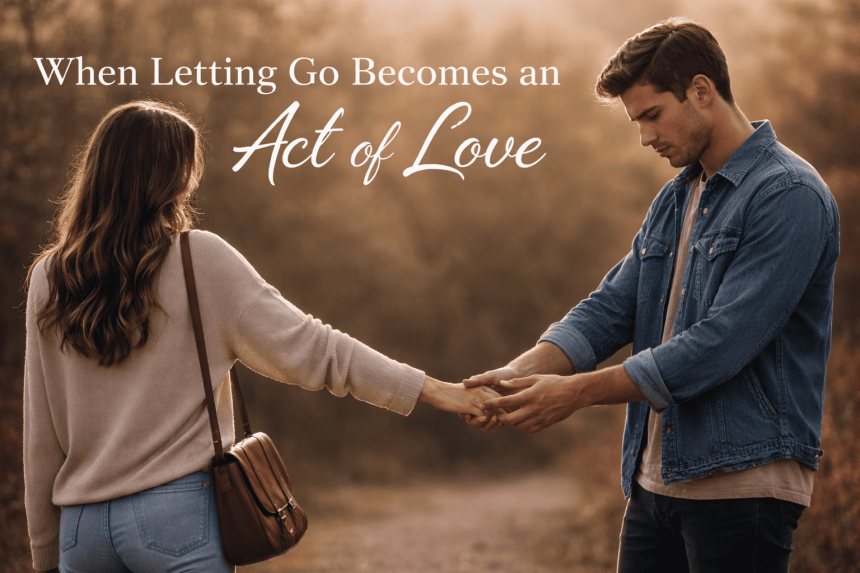
When Letting Go Becomes an Act of Love is one of the hardest truths to accept in relationships. We are taught that love means holding on, fighting harder, and never giving up. But sometimes, the most loving thing you can do—for yourself and for someone else—is to step back. Letting go does not always mean the absence of love; often, it is the result of loving deeply while recognizing that staying is causing more pain than peace.
When Letting Go Is an Act of Love
Letting go is often misunderstood as weakness, failure, or emotional defeat. In reality, it is one of the strongest decisions a person can make. Love is not measured by how much pain you can endure, how long you can wait, or how much of yourself you are willing to lose. Real love includes respect, emotional safety, growth, and mutual effort. When these disappear, holding on becomes an act of fear—not love.
Many people stay in relationships far longer than they should because of memories, promises, shared history, or the hope that things will change. Hope can be beautiful, but when it becomes the only thing holding a relationship together, it turns into emotional self-harm. Letting go at that point is not selfish; it is self-preserving.
Letting Go Doesn’t Mean You Didn’t Care
One of the biggest myths about letting go is that it means the love wasn’t real. In truth, people often let go because the love was real. They recognize that forcing someone to stay, change, or love them back is unfair. Love cannot grow in pressure, guilt, or emotional exhaustion.
Sometimes, love means allowing someone the freedom to walk their own path—even if that path no longer includes you. This kind of love is quiet, painful, and incredibly mature.
When Staying Hurts More Than Leaving
There comes a moment when staying begins to cost you your peace, confidence, and self-worth. You may feel anxious all the time, overthink every interaction, or constantly question your value. Love should not feel like emotional survival.
Letting go becomes an act of love when:
- You are the only one trying
- Your needs are consistently ignored
- Respect has been replaced by control or indifference
- You feel lonely even when you’re together
- You are shrinking yourself to keep the relationship alive
Walking away in these moments is not giving up—it is choosing emotional health over emotional attachment.
Loving Someone Without Possessing Them
True love does not mean possession. It does not demand sacrifice at the cost of your identity. Letting go acknowledges that love does not guarantee compatibility, timing, or shared growth. Two people can love each other deeply and still be wrong for each other.
When you let go, you allow love to transform—from attachment into understanding, from closeness into gratitude, and from pain into growth.
Letting Go Is Also Loving Yourself
One of the most overlooked truths is that letting go is an act of self-love. You are honoring your boundaries, your emotional limits, and your worth. Loving yourself does not mean you loved the other person less—it means you finally loved yourself enough.
Self-love teaches you that you deserve consistency, effort, emotional safety, and peace. Letting go creates space for healthier love—whether that love comes from someone new or from a deeper relationship with yourself.
Healing After Letting Go
Letting go doesn’t instantly erase pain. There will be grief, confusion, and moments of doubt. Healing is not linear. But over time, clarity replaces chaos. You begin to recognize patterns, lessons, and strengths you didn’t know you had.
What once felt like loss slowly feels like relief.
When Letting Go Is the Greatest Expression of Love
Letting go becomes an act of love when it is done with honesty, compassion, and courage. When it is chosen not out of anger, but out of awareness. When it protects hearts instead of breaking them further.
Love is not always about staying.
Sometimes, love is knowing when to leave.