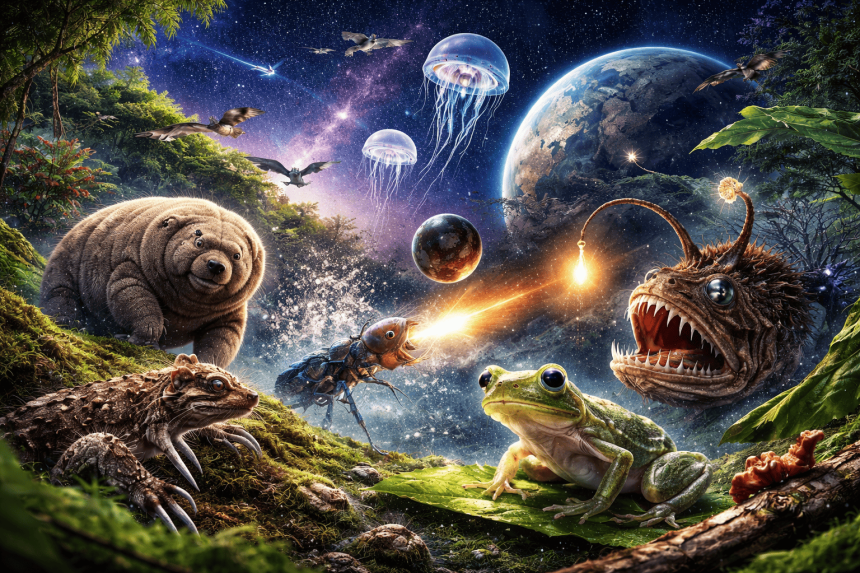
Science constantly challenges our understanding of the world, but some discoveries are so bizarre that they seem impossible. From living creatures that survive in extreme conditions to objects behaving in ways that defy physics, these weird scientific discoveries push the boundaries of reality. In this blog, we’ll explore some of the most astonishing findings, explaining not just what happened, but how and why they occur.
1. Tardigrades: The Ultimate Survivors
Tardigrades, often called water bears, are microscopic creatures measuring less than a millimeter. Despite their tiny size, they are one of the toughest life forms on Earth. Tardigrades can survive:
- Extreme heat: up to 151°C (304°F)
- Extreme cold: down to -272°C (-458°F), nearly absolute zero
- Radiation: hundreds of times more than humans can tolerate
- Vacuum of space: no oxygen, zero pressure
How They Do It
Tardigrades survive using a state called cryptobiosis, where they dry out completely and shut down all metabolic activity. In this state, they produce a sugar called trehalose, which protects their cells and DNA from damage. When water becomes available again, tardigrades rehydrate and “come back to life,” sometimes after decades in cryptobiosis.
Why It Seems Impossible
Life typically cannot endure vacuum or extreme radiation. Tardigrades challenge our fundamental understanding of what it means to be alive, making them one of the most extraordinary scientific discoveries.
2. The Immortal Jellyfish: Defying Aging
The Turritopsis dohrnii jellyfish can reverse its aging process, earning it the title of the “immortal jellyfish.”
How It Happens
When faced with injury or environmental stress, the jellyfish undergoes cellular transdifferentiation, where adult cells transform back into earlier-stage polyp cells. This means the jellyfish can cycle indefinitely between youth and adulthood, avoiding death due to old age.
Fascinating Facts
- First observed in the Mediterranean Sea.
- Theoretically, it could live forever if not eaten by predators or destroyed by disease.
- Provides insights into cellular regeneration, which could one day inform human anti-aging research.
Why It Seems Impossible
Aging has long been considered inevitable for multicellular organisms. A creature that can essentially reset its life cycle overturns this fundamental assumption.
3. Bacteria That Eat Metals
In 2010, scientists discovered a species called Cupriavidus metallidurans, bacteria that thrive in environments full of heavy metals such as gold, uranium, and nickel.
How It Works
These bacteria detoxify heavy metals through biomineralization, turning toxic substances into safe compounds. Amazingly, in the process, they can create tiny nuggets of gold. This has potential applications in biotechnology and mining.
Why It Seems Impossible
No living organism was previously known to metabolize heavy metals. That bacteria could survive, and even prosper, in such extreme conditions challenges our understanding of life’s limitations.
4. Spontaneous Human Combustion
Cases of spontaneous human combustion (SHC) have been reported for centuries, where individuals catch fire without an external ignition source.
Possible Explanations
While SHC is controversial, scientists hypothesize that:
- Metabolic disorders may produce flammable compounds like acetone.
- A phenomenon called the wick effect could allow body fat to act as fuel in rare circumstances.
Why It Seems Impossible
The human body is not normally flammable. Cases where a person burns extensively without an external source of ignition defy conventional understanding and remain partially unexplained.
5. Plants That Can “Hear”
It may sound impossible, but plants can sense vibrations and react to sounds, such as the chewing of insects.
How It Works
- Plants have mechanoreceptors in their cells that detect vibrations.
- These vibrations trigger chemical changes that produce defensive compounds.
Examples
- Mimosa pudica folds its leaves when touched.
- Some crops produce more protective enzymes when exposed to herbivore chewing vibrations.
Why It Seems Impossible
Without a nervous system or brain, plants exhibit behavior similar to hearing and responding to danger, demonstrating a hidden layer of intelligence in flora.
6. Quantum Entanglement in Everyday Matter
Quantum entanglement was once thought to occur only at subatomic levels. Now, researchers have observed entanglement in small clusters of atoms.
How It Works
Entangled particles remain connected regardless of distance, so a change in one instantly affects the other. Scientists achieve this using:
- Lasers
- Extremely low temperatures
- Magnetic fields
Potential Applications
- Quantum computing
- Ultra-secure communication
Why It Seems Impossible
Entanglement contradicts classical physics and common sense. The idea that one object can instantaneously affect another, even miles away, seems straight out of science fiction.
7. Devil’s Hole Pupfish: Isolation Experts
The Devil’s Hole pupfish lives in a single underground water pocket in Nevada.
Extreme Conditions
- Small habitat: roughly the size of a bathtub
- High temperatures: up to 93°F (34°C)
- Minimal food
How They Survive
- Highly efficient metabolism
- Extremely slow reproduction rate
- Adapted to conserve energy and survive nutrient scarcity
Why It Seems Impossible
A species surviving in such extreme isolation with no genetic diversity for thousands of years seems improbable, yet the pupfish has persisted for over 10,000 years.
8. Zombie Ant Fungus
The fungus Ophiocordyceps unilateralis manipulates ants’ behavior to spread its spores.
How It Works
- The fungus infects an ant and releases chemicals affecting its nervous system.
- The ant climbs vegetation and locks its jaws onto a leaf.
- The fungus then grows out of the ant, releasing spores to infect more ants.
Why It Seems Impossible
A fungus controlling the behavior of a complex animal like an ant is something that sounds like a horror movie, yet it’s been repeatedly observed in nature.
9. Animals Sensing Magnetic Fields
Many animals navigate using Earth’s magnetic field, including:
- Migratory birds
- Sea turtles
- Salmon
How It Works
- Magnetoreceptors in the body contain iron-based proteins or radical pair mechanisms sensitive to magnetic fields.
- This guides navigation across continents and oceans.
Why It Seems Impossible
Humans cannot detect magnetic fields, so it’s astonishing that other animals possess a built-in compass, giving them a sense entirely alien to us.
10. Rogue Planets: Lonely Wanderers
Astronomers have discovered rogue planets drifting through space without orbiting any star.
How It Happens
- Formed in stellar systems but ejected by gravitational interactions.
- Detected using gravitational microlensing, which measures how a planet’s gravity bends light from a distant star.
Why It Seems Impossible
Planets were thought to always orbit stars. These wandering worlds challenge everything we thought we knew about planetary formation.
11. Bioluminescent Animals in the Deep Sea
Deep-sea creatures like the anglerfish produce light in total darkness.
How It Works
- Special chemicals like luciferin react with oxygen to create light.
- Bioluminescence is used for hunting, mating, and camouflage.
Why It Seems Impossible
Life can survive in complete darkness at extreme pressures and produce its own light, which seems completely alien compared to life on land.
12. Water That Freezes Hotter Than Ice Water (Mpemba Effect)
The Mpemba effect is a phenomenon where hot water can freeze faster than cold water under certain conditions.
How It Works
- Supercooling, convection currents, and evaporation play roles.
- Exact mechanisms remain partially mysterious, despite repeated observation.
Why It Seems Impossible
Intuition tells us cold water should freeze faster, yet experiments show the opposite, challenging our understanding of thermodynamics.
13. Glass Frogs: Transparent Anatomy
Glass frogs have translucent skin on their undersides, allowing you to see their internal organs, including the heart and digestive system.
How It Works
- Their skin contains specialized cells that minimize light scattering, making tissues transparent.
- This transparency likely evolved as a camouflage mechanism, making it harder for predators to spot them in foliage above streams.
Fascinating Facts
- Found mostly in Central and South America.
- Some species’ bones are even partially transparent.
Why It Seems Impossible
Seeing an animal’s internal organs without dissection is counterintuitive; nature rarely allows such visibility, yet glass frogs defy our expectations of anatomy.
14. Immortal Planarian Worms
Planarian flatworms can regenerate entire bodies from tiny fragments.
How It Works
- They have an extraordinary number of pluripotent stem cells, called neoblasts, that can become any cell type.
- Even a fragment as small as 1/279th of the original worm can regenerate a complete individual.
Fascinating Facts
- Researchers study planarians for insights into regeneration and stem cell therapy.
- They can survive repeated amputations without aging significantly.
Why It Seems Impossible
Most animals cannot regenerate beyond simple tissue repair. Planarians challenge our understanding of growth and cellular potential.
15. Pistol Shrimp: The Underwater Gun
The pistol shrimp can stun or kill prey using sound, creating a miniature underwater explosion.
How It Works
- The shrimp snaps its claw shut at over 100 km/h, generating a cavitation bubble.
- The bubble reaches temperatures of 4,700°C (8,500°F) and emits a shockwave and light flash called sonoluminescence.
Fascinating Facts
- The sound can reach 218 decibels, louder than a gunshot.
- Shrimp use this to hunt prey larger than themselves.
Why It Seems Impossible
The shrimp is tiny—yet it produces one of the most extreme mechanical and thermal phenomena in nature, almost like wielding a firearm.
16. Antimatter Particles in Space
Scientists have observed antimatter particles naturally produced in cosmic rays hitting Earth.
How It Works
- Cosmic rays collide with atoms in the atmosphere, producing positrons (anti-electrons) and other antiparticles.
- Advanced detectors like the Alpha Magnetic Spectrometer (AMS) track these particles.
Fascinating Facts
- Antimatter annihilates matter on contact, releasing huge energy.
- Studying antimatter helps physicists understand the Big Bang and universe asymmetry.
Why It Seems Impossible
Antimatter was once considered purely theoretical. The fact that it exists naturally in space challenges our assumptions about the composition of the universe.
17. The Baigong Pipes: Mysterious Iron Structures
Inside a remote Chinese mountain, scientists discovered iron pipes embedded in rock, some dating tens of thousands of years old.
How It Works (Theories)
- Some suggest ancient humans created them, though no evidence of such advanced technology exists.
- Natural processes like mineral deposition along water pathways might explain their formation.
Why It Seems Impossible
Metal pipes inside rock that predates human civilization appear to contradict geology and archaeology, making them a tantalizing unsolved mystery.
18. Hairy Frogs: The “Wolverine” Defense Mechanism
The hairy frog grows bone claws that pierce through its own skin when threatened.
How It Works
- Small bone spikes grow along the frog’s fingers.
- In a defensive maneuver, the frog breaks its own bones through the skin, using them as claws against predators.
Fascinating Facts
- Found in Central Africa.
- The “hair” on its sides is actually keratinized skin used during mating season.
Why It Seems Impossible
Animals typically avoid harming themselves for defense. Hairy frogs deliberately injure themselves, a bizarre adaptation almost unbelievable in nature.
19. Cat Righting Reflex: Falling Unscathed
Cats can survive high falls without injury due to their unique righting reflex.
How It Works
- Cats rotate their flexible spines mid-air to land on their feet.
- Their low body weight and loose skin act as a parachute, reducing terminal velocity.
Fascinating Facts
- Falls from 2–6 stories are often survivable; higher falls can sometimes be fatal due to terminal velocity.
- Studied by scientists to understand biomechanics and aerodynamics.
Why It Seems Impossible
A living creature can fall several stories and survive, defying the expectations of physics and gravity.
20. Glow-in-the-Dark Sharks
Some shark species are bioluminescent, producing light from their bodies.
How It Works
- Special light-producing cells called photophores emit a faint glow.
- Used for camouflage, hunting, and communication in the deep ocean.
Fascinating Facts
- Found in depths over 200 meters.
- The glow is invisible from above but lights the sea floor to confuse prey.
Why It Seems Impossible
Sharks are predators we associate with darkness and stealth, yet evolution gave them an ability to emit light—something that seems alien and counterintuitive.
Conclusion
Weird scientific discoveries reveal that the universe is far stranger than we imagine. From immortal jellyfish to metal-eating bacteria, rogue planets, and plants that “hear,” these phenomena push the boundaries of possibility. Each discovery expands our understanding of life, physics, and the natural world, reminding us that science often uncovers truths that defy logic and challenge our perception of reality.