


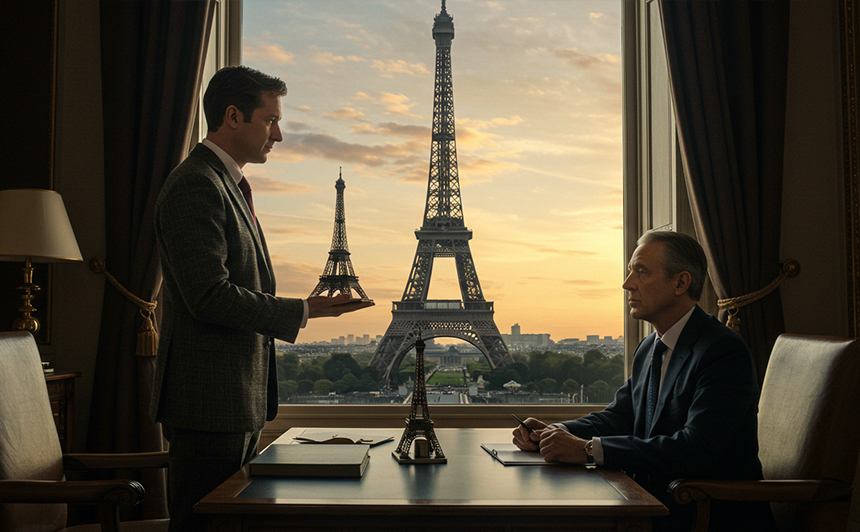
In 1925, the man who sold the Eiffel Tower twice pulled off one of the most audacious scams in history—not once, but two times. His name was Victor Lustig, a master manipulator who didn’t just trick wealthy businessmen… he even outsmarted the mafia.
How did he convince people to buy Paris’s most famous landmark? And why did the same scheme work a second time? This is the story of a con artist so brilliant, his legend lives on a century later.
Chapter 1: The Setup – Why the Eiffel Tower?
A Perfect Target
- The Eiffel Tower was unpopular in the 1920s—many Parisians saw it as an eyesore.
- Rumors swirled that the government might dismantle it for scrap metal.
- Lustig saw an opportunity: What if someone “official” sold it first?
The Forged Documents
Posing as a French government official, Lustig:
✅ Created fake letterhead from the “Ministry of Posts and Telegraphs”
✅ Hired a bogus “assistant” to play his secretary
✅ Rented a luxury hotel suite to host “private meetings”
Chapter 2: The First Sale – How It Worked
The Mark: André Poisson
Lustig targeted greedy scrap metal dealers, including Poisson, with this pitch:
“The city can no longer afford maintenance. We’re quietly selling it to the highest bidder.”
The Genius Psychological Trick
To make it seem real, Lustig:
- Refused bribes at first (building trust)
- Later hinted, “Perhaps a small ‘consultation fee’ would speed things up…”
- Poisson paid 70,000∗∗(≈∗∗70,000∗∗(≈∗∗1.2 million today) for “exclusive rights”
The Escape
Lustig fled to Austria before Poisson realized the scam. But here’s the twist…
Chapter 3: The Second Sale – Even Bolder
Why It Worked Again
- Poisson was too embarrassed to report the crime.
- Lustig returned to Paris months later and tried the same scam.
- This time, the victim got suspicious and went to police—forcing Lustig to flee to America.
Chapter 4: The Con Artist Who Scammed Al Capone
Lustig’s Other Famous Fraud
In Chicago, Lustig convinced Al Capone to invest $50,000 in a “stock deal.”
- He held the money for two months, then returned it, saying:
“The deal fell through… your principles impressed me.” - Capone was so flattered, he gave Lustig $5,000 for his “honesty.”
His Downfall
Lustig was finally arrested in 1935 for counterfeiting—after 47 aliases and scams across Europe and America.
Chapter 5: Why This Story Still Fascinates Us
Lessons from History’s Boldest Con
- Greed blinds logic (both victims ignored obvious red flags).
- Confidence is the ultimate weapon (Lustig’s acting skills were flawless).
- Even genius criminals slip up (his ego led to his arrest).
The Eiffel Tower’s Ironic Legacy
Today, the Tower is beloved—but Lustig’s scam remains a darkly hilarious footnote.
Conclusion: The Ultimate Hustler
The man who sold the Eiffel Tower twice proved that the best lies contain a grain of truth. His story reminds us: if a deal seems too good to be true… it’s probably a con.
Want more insane scams?
Read next


