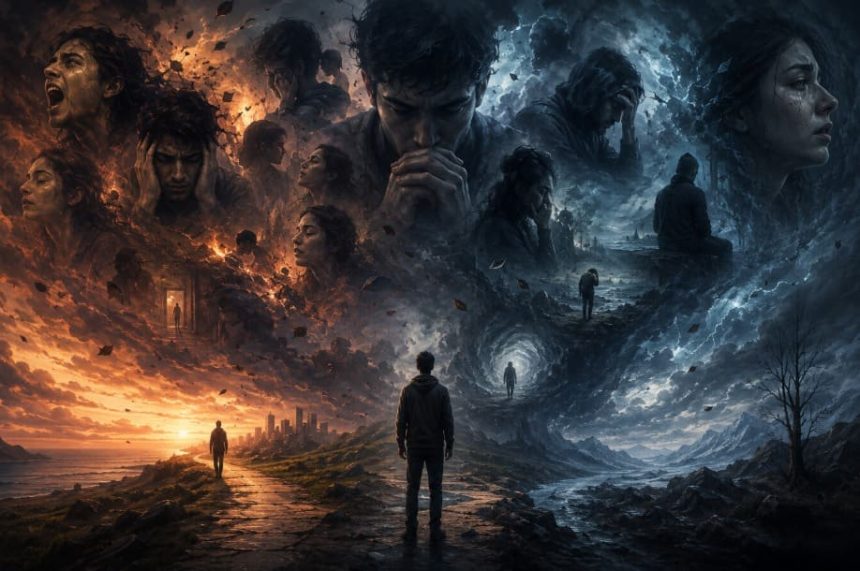
Most Intense Human Emotion Truth is often misunderstood because most people assume love is the strongest feeling a human can experience. While love is powerful, comforting, and deeply transformative, it is not always the most overwhelming emotion we face. There are moments in life where emotions go beyond affection—reaching states of fear, grief, obsession, or even existential emptiness that feel far more consuming. These emotions can take control of thoughts, distort perception, and linger far longer than love ever does. In reality, the human emotional spectrum is far more complex than a single feeling, and what we often overlook is that the most intense emotions are usually the ones tied to loss, uncertainty, or internal conflict rather than connection alone.
1. Fear of Loss
Fear is often more powerful than love because it doesn’t wait for reality—it creates imaginary suffering in advance. The fear of losing someone, something, or even yourself can consume the mind long before anything actually disappears. It tightens the chest, disturbs sleep, and reshapes thoughts into worst-case scenarios. Unlike love, which can feel warm and grounding, fear destabilizes everything you thought was under control. It is silent, but it spreads like fire inside the mind.
2. Grief After Separation
Grief doesn’t just come from death—it comes from endings of any emotional bond. When someone leaves, or a phase of life closes, the emotional weight feels heavier than love ever did. You don’t just miss the person; you miss the version of yourself that existed with them. Grief has no logic, no timeline, and no fairness. It lingers in ordinary moments, making even silence feel loud.
3. Emotional Abandonment
Being emotionally abandoned is one of the deepest psychological wounds a human can experience. It is not just about someone leaving—it is about being left while still present in their life. This creates confusion, self-doubt, and an internal questioning of worth. Unlike love, which builds connection, abandonment fractures identity itself.
4. Obsession
Obsession takes emotion beyond balance. It is love without boundaries, fear without control, and desire without rest. It consumes thoughts until nothing else feels important. A person in obsession does not simply feel—they get trapped inside repetition. It is not peaceful like love; it is consuming like a loop that never stops.
5. Loneliness
Loneliness is not the absence of people—it is the absence of emotional understanding. A person can be surrounded by others and still feel completely isolated inside. This emotion slowly erodes self-worth and makes silence feel heavy. Unlike love, which connects, loneliness disconnects even the mind from itself.
6. Betrayal
Betrayal breaks something deeper than trust—it breaks emotional reality. When someone you believed in turns into the source of pain, the mind struggles to reconcile memory with truth. This contradiction creates emotional shock that can last longer than love ever did. Betrayal doesn’t just hurt; it reshapes how you see people.
7. Jealousy
Jealousy is a quiet but intense emotional storm. It mixes fear, insecurity, and comparison into one overwhelming feeling. It doesn’t always show on the outside, but inside it creates constant mental tension. Unlike love, which expands, jealousy shrinks your sense of self.
8. Regret
Regret is an emotion that travels backward in time. It forces the mind to replay moments that cannot be changed. It is painful because it combines awareness with helplessness. People can survive heartbreak, but regret often continues long after the situation is gone, shaping future decisions through past pain.
9. Existential Emptiness
This is the feeling of emotional void where nothing feels meaningful, even things that once mattered deeply. It is not sadness in a simple sense—it is disconnection from purpose itself. This state can be more intense than love because it removes emotional direction completely, leaving only silence inside.
10. Internal Conflict
Internal conflict is when emotions fight each other within the same mind. One part wants to move on, another wants to hold on. One part believes, another doubts. This emotional contradiction creates exhaustion that love alone cannot resolve. It is the battlefield where human emotion becomes most intense—not in connection, but within the self.
11. Anxiety of Uncertainty
Anxiety is the mind’s inability to accept not knowing what comes next. It doesn’t need a real problem to exist—it thrives in possibilities. The future becomes a threat rather than a hope, and even small decisions feel heavy. Unlike love, which anchors you in connection, anxiety pulls you into endless mental simulations of what could go wrong. It is exhausting because it never stays in the present moment.
12. Emotional Numbness
Emotional numbness is not the absence of feeling—it is the overload of too many feelings for too long. The mind shuts down emotionally to protect itself. In this state, even love feels distant, like a memory of something once understood but no longer accessible. What makes it intense is not pain, but the absence of reaction itself, where nothing feels good or bad anymore.
13. Heartbreak Collapse
Heartbreak is often described as sadness, but in its deepest form, it is psychological collapse. The emotional system that once revolved around a person suddenly loses its center. Thoughts become fragmented, daily life feels unfamiliar, and even time seems distorted. Unlike love, which builds emotional structure, heartbreak dismantles it completely.
14. Self-Doubt Spiral
Self-doubt is a slow emotional erosion. It doesn’t attack suddenly; it whispers repeatedly until confidence weakens. A person begins questioning every choice, every emotion, every identity they once trusted. Compared to love, which affirms existence, self-doubt erases it piece by piece until certainty becomes almost impossible.
15. Rejection Pain
Rejection hits deeper than simple disappointment—it affects identity. It tells the mind that it was not enough, not chosen, not valued. This creates emotional shock that often lingers far longer than the moment itself. Unlike love, which includes acceptance, rejection creates internal fragmentation between who you are and who you thought you were.
16. Emotional Dependency
Dependency forms when emotional stability is placed entirely outside the self. One person becomes the source of peace, validation, and meaning. When that connection weakens, the internal world collapses quickly. This intensity often exceeds love because it removes independence and replaces it with emotional survival based on another person’s presence.
17. Shame
Shame is one of the most silent yet powerful emotions. It doesn’t just say “I did something wrong”—it says “I am wrong.” It hides people from the world and from themselves. Unlike love, which opens emotional expression, shame closes every door inward until even self-acceptance feels unreachable.
18. Suppressed Anger
Anger that is never expressed doesn’t disappear—it compresses. Over time, it turns inward or explodes unpredictably. This suppressed emotional pressure creates internal tension that affects both mind and body. Unlike love, which flows outward, suppressed anger stagnates and grows heavier with time.
19. Emotional Exhaustion
This is the state where feeling itself becomes tiring. After prolonged emotional highs and lows, the mind stops responding with energy. Even meaningful things feel distant because the system is depleted. Unlike love, which energizes connection, emotional exhaustion removes the ability to engage fully with anything.
20. Identity Crisis
An identity crisis occurs when a person no longer recognizes who they are without certain emotions, people, or experiences. The internal sense of self becomes unstable. Thoughts like “Who am I without this?” become constant. Unlike love, which adds meaning, identity crisis removes structure, leaving the mind in a state of confusion and reconstruction.
21. Emotional Detachment
Emotional detachment is when the mind consciously or unconsciously disconnects from feelings to avoid further pain. It is not peace—it is protection. People in this state still function, still speak, still exist in daily life, but something essential feels missing inside. Unlike love, which connects deeply, detachment creates distance from everything, including one’s own emotions.
22. Existential Fear
This is the fear of existence itself—questions like why we are here, what life truly means, and whether anything matters at all. It appears suddenly in quiet moments and grows in silence. Unlike love, which gives purpose through connection, existential fear removes certainty from everything, making reality itself feel unstable and overwhelming.
23. Emotional Confusion
Emotional confusion happens when multiple feelings exist at once without clarity or direction. Love, anger, fear, and longing can overlap until nothing makes sense anymore. The mind struggles to label what it feels, which intensifies the distress. Unlike love, which is often clear in direction, confusion dissolves emotional understanding completely.
24. Nostalgia Pain
Nostalgia is not always comforting—it can become deeply painful when the past feels better than the present. It traps the mind in memories that cannot be relived. The more beautiful the memory, the deeper the ache. Unlike love, which exists in the present, nostalgia exists in loss disguised as memory.
25. Powerlessness
Powerlessness is the emotion of having awareness without control. You see what is happening, you understand it, but you cannot change it. This creates deep internal frustration and emotional heaviness. Unlike love, which gives a sense of influence and connection, powerlessness removes all sense of agency.
26. Anticipatory Grief
This is grief felt before loss actually happens. The mind begins mourning something or someone still present, preparing itself for pain that has not yet arrived. It creates emotional exhaustion over time. Unlike love, which lives in presence, anticipatory grief lives in imagined absence.
27. Emotional Overthinking
Overthinking turns emotions into endless loops of analysis. Every feeling is examined, replayed, and questioned until it loses natural flow. This creates mental fatigue and emotional distortion. Unlike love, which feels intuitive, overthinking removes emotional simplicity and replaces it with constant mental noise.
28. Inner Void
The inner void is a deep sense of emptiness that cannot be filled by external experiences. It is not sadness or anger—it is absence. Even positive moments feel temporary and disconnected. Unlike love, which creates fullness, the void feels like emotional silence where meaning struggles to exist.
29. Trust Breakdown
When trust breaks, it doesn’t just affect one relationship—it affects how all future connections are perceived. The mind becomes guarded, cautious, and less open. Unlike love, which builds openness, broken trust builds invisible emotional walls that are difficult to remove.
30. Emotional Transformation
This is the final stage where intense emotions reshape a person entirely. After experiencing fear, loss, pain, and confusion, the mind no longer returns to its previous state. Unlike love, which is often seen as completion, emotional transformation is rebirth through emotional intensity—where a person becomes fundamentally changed by what they felt.