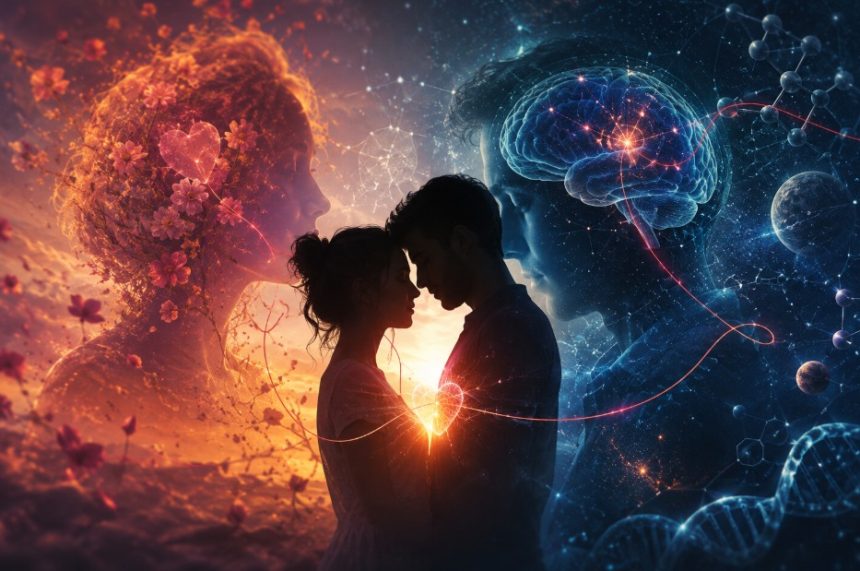
Love is often described as one of the most beautiful mysteries of human existence. Some people believe that every meaningful relationship is guided by destiny, while others see love as the result of biology, psychology, and emotional experiences. Yet neither explanation seems complete on its own. The truth is that love exists at the fascinating intersection of logic and feeling, where chemical reactions in the brain meet emotions that can transform lives. The connection between science and emotion behind love and fate reveals how human relationships are influenced by both measurable processes and deeply personal experiences. Understanding this balance helps us appreciate why love can feel both scientifically explainable and magically destined at the same time.
1. Subconscious Beginning of Love
Love usually starts before we even realize it consciously. The brain quietly processes signals like facial expressions, tone of voice, energy, and familiarity within seconds of meeting someone. Neurochemicals like dopamine begin activating reward pathways, creating a sense of curiosity and attraction. This early stage feels sudden, but it is actually the result of fast subconscious evaluation. Even so, people often describe it as an “instant connection,” which is where emotional interpretation begins to overlap with the idea of fate.
2. Brain Chemistry and Emotional Bonding
As attraction deepens, brain chemistry becomes more complex. Dopamine fuels excitement and desire, while oxytocin builds trust, comfort, and emotional attachment. Vasopressin supports long-term bonding and emotional security. These chemicals make a person feel emotionally significant and irreplaceable. Although science explains these processes clearly, the emotional experience often feels deeply personal and meaningful, leading people to believe that such strong connections cannot be purely biological.
3. Pattern-Seeking Mind and Signs of Fate
The human brain naturally looks for patterns, even in random events. When two people experience repeated encounters or coincidences, the mind connects them into a meaningful story. This psychological tendency makes relationships feel “guided” or “meant to be.” Small coincidences—like meeting unexpectedly or sharing similarities—become emotional signs. This is how the idea of fate often forms, even when events are simply chance occurrences.
4. Emotional Memory and Lasting Impact
Love becomes unforgettable because emotional experiences are strongly stored in the brain. The amygdala and hippocampus preserve moments of joy, pain, and intimacy with high intensity. This is why certain relationships stay vivid for years, even after they end. Over time, memory becomes less about accuracy and more about emotional meaning, often making past relationships feel more significant or “destined” than they may have actually been.
5. The Power of Timing in Relationships
Timing plays a crucial role in whether love develops or fades. Two people may be perfect for each other but meet at the wrong emotional stage of life. When individuals meet during periods of emotional readiness, connection feels effortless and natural. This smooth alignment creates the illusion of fate, even though it is often the result of personal growth and life circumstances aligning at the right moment.
6. Attachment Styles and Relationship Intensity
Attachment theory explains why people love differently based on early childhood experiences. Secure, anxious, and avoidant attachment styles shape emotional behavior in relationships. When contrasting styles interact, the emotional intensity can become very strong and sometimes unstable. These intense dynamics often feel like “fated attraction,” but they are actually rooted in learned emotional patterns and psychological conditioning.
7. Cultural Influence on Love and Destiny
Culture strongly shapes how people interpret love. Movies, books, and myths often portray love as destined or written by fate. These stories influence real-life expectations, making people more likely to see deep emotional connections as meaningful or predestined. Over time, cultural narratives become personal belief systems, reinforcing the idea that strong love must feel extraordinary or “meant to happen.”
8. Randomness Behind Life Encounters
From a scientific perspective, most relationships are the result of probability and chance. Factors like location, timing, environment, and daily choices all influence who we meet. When all these variables align, the encounter feels special or rare. However, the human mind struggles to accept randomness in emotional situations, so it converts chance into meaningful destiny to create emotional comfort and understanding.
9. Human Consciousness and Emotional Meaning
Love cannot be fully explained by science alone because human consciousness adds meaning to experience. People interpret emotions through memory, imagination, and identity, which makes each relationship unique. Even if two situations are scientifically similar, they feel different because of personal perception. This subjective experience is why love often feels deeper than biological explanation and resists complete scientific definition.
10. Love as the Balance of Science and Fate
Ultimately, love exists where science and emotion meet. Biology explains attraction, psychology explains behavior, and neuroscience explains bonding, but feelings give everything meaning. Fate becomes a way for humans to describe powerful emotional experiences that feel too significant to be random. Whether love is created by chemistry or interpreted as destiny, its emotional impact is real, powerful, and life-changing.
11. The Illusion of “Meant to Be” Moments
Many relationships feel destined because of emotionally powerful “first moments” that stand out in memory. A first conversation that flows easily, a sudden meeting in an unexpected place, or a shared laugh at the right time can feel like signs from the universe. Psychologically, these moments are amplified because the brain gives higher importance to emotionally charged experiences. Instead of seeing them as isolated events, the mind connects them into a larger narrative, creating the illusion that everything was carefully aligned. This is how ordinary beginnings are often transformed into extraordinary emotional meaning.
12. Emotional Projection in Love
When people fall in love, they often project their inner desires, hopes, and unmet emotional needs onto another person. This means the emotional experience is not only about who the other person is, but also about what they represent. The brain fills emotional gaps with imagination, creating an idealized version of love. This projection can make a connection feel deeper or more significant than it objectively is. In this process, the feeling of “destiny” is strengthened because the relationship seems to perfectly match internal emotional longing.
13. The Role of Uncertainty in Attraction
Uncertainty plays a powerful role in intensifying emotional attraction. When outcomes are unpredictable, the brain releases more dopamine, increasing focus and emotional engagement. This is why inconsistent attention or emotional ambiguity can sometimes strengthen feelings of attachment. The mind becomes more invested, constantly trying to predict outcomes. This heightened emotional state can feel like a magnetic pull, often misinterpreted as fate, when in reality it is the brain reacting to uncertainty and anticipation.
14. Emotional Dependency and Deep Attachment
As love develops, emotional dependency can form, where a person becomes a central source of emotional stability and happiness. This dependency is reinforced through repeated emotional reinforcement cycles, where positive experiences strengthen attachment. The brain begins to associate one person with comfort, safety, and emotional relief. Over time, this can create a powerful sense of connection that feels irreplaceable. In this state, individuals may believe the bond is destined, because it feels too strong to be accidental or temporary.
15. Shared Pain and Emotional Bonding
One of the strongest forms of connection is formed through shared emotional pain or vulnerability. When two people experience difficult moments together, the brain links them through emotional survival processing. This creates a deep sense of trust and understanding. Psychological studies show that vulnerability increases bonding because it reduces emotional barriers between individuals. These intense emotional experiences often leave a lasting impression, making the relationship feel meaningful and sometimes “fated” due to the depth of shared experience.
16. The Psychology of “Right Person” Belief
The belief in a “right person” is often shaped by emotional experiences rather than objective reality. When someone experiences strong emotional resonance with another person, the brain tends to categorize them as uniquely important. This categorization is influenced by emotional contrast—how different or intense the connection feels compared to past experiences. As a result, people may believe they have found “the one,” even though this perception is shaped by emotional intensity, timing, and psychological comparison.
17. Memory Distortion in Past Love
Over time, memories of love are not stored as exact records but are reconstructed each time they are recalled. This means emotional intensity can alter how past relationships are remembered. Painful or beautiful moments may become exaggerated, while neutral details fade away. As a result, past love can feel more significant in memory than it was in reality. This distortion strengthens the idea that certain relationships were special or destined, because memory emphasizes emotional meaning over factual accuracy.
18. The Brain’s Need for Emotional Closure
Human psychology seeks closure in emotionally unresolved situations. When relationships end without clarity or explanation, the brain continues searching for meaning. This unresolved emotional loop can lead people to romanticize the connection and assign deeper significance to it. The lack of closure often turns into lingering emotional attachment, which may feel like unfinished destiny. In reality, it is the mind’s natural resistance to incomplete emotional narratives.
19. The Conflict Between Logic and Emotion
Love often creates a conflict between rational thinking and emotional experience. While logic analyzes compatibility, timing, and reality, emotions focus on intensity, attachment, and feeling. This internal conflict can make relationships feel confusing but powerful at the same time. When emotion dominates, individuals may dismiss logical explanations and rely on intuition instead. This emotional dominance contributes to the belief in fate, as feelings often appear more convincing than reasoning in matters of love.
20. Love as a Meaning-Making Experience
Ultimately, love is not just a biological or psychological process but also a meaning-making experience. Humans naturally seek significance in emotional events, especially those that deeply affect identity and happiness. Love becomes a space where science explains mechanisms, but emotion defines importance. The idea of fate emerges as a way to give structure to powerful feelings that feel too profound to be random. In this way, love becomes both a scientific process and a deeply personal story shaped by interpretation.
21. The Brain’s Reward System and Emotional Addiction
Love activates the brain’s reward system in a way that closely resembles addictive behavior. Dopamine surges create anticipation, pleasure, and emotional craving whenever a person is near or thinking about someone they love. This reward loop reinforces attachment by making the presence of that person feel emotionally essential. Over time, the brain begins to associate love with reward-seeking behavior, which explains why separation can feel physically and emotionally uncomfortable. This intense neurochemical pattern can make love feel overwhelming and uncontrollable, often mistaken as a force beyond human psychology.
22. The Chemistry of Longing and Absence
Absence plays a powerful role in strengthening emotional attachment because it disrupts the brain’s reward cycle. When a loved one is not present, dopamine levels fluctuate, creating feelings of longing and emotional anticipation. This absence intensifies mental focus on the person, often making them appear more significant than in constant presence. Psychologically, the mind tends to idealize what is missing, filling gaps with imagination. This is why distance can sometimes deepen emotional attachment and create a stronger belief that the connection is special or destined.
23. The Role of Emotional Synchrony
Emotional synchrony occurs when two individuals begin to mirror each other’s emotions, behaviors, and communication styles. This unconscious alignment strengthens feelings of connection and understanding. Neuroscience suggests that humans are naturally wired for empathy, allowing emotional states to transfer between individuals through subtle cues. When synchrony develops, people often feel “in tune” with each other, as if they naturally understand one another without explanation. This deep sense of alignment can feel like fate, even though it is rooted in social and emotional mimicry.
24. The Impact of Shared Experiences
Shared experiences create powerful emotional bonds because the brain encodes collective memories as meaningful social connections. When two people go through important life events together—whether joyful, stressful, or transformative—their brains link those experiences with emotional trust. These shared memories become reference points in the relationship, strengthening attachment over time. The more emotionally significant the experience, the deeper the bond feels. This accumulation of shared meaning often contributes to the belief that the relationship was “meant to happen.”
25. The Influence of Personal Growth Cycles
Individuals constantly evolve through emotional and psychological growth cycles, which affect how they form relationships. Sometimes two people meet during parallel stages of growth, where their emotional needs and life perspectives align naturally. This alignment creates a sense of ease and understanding that feels rare or extraordinary. In reality, it is the result of internal development rather than external destiny. However, because the timing feels perfect, the connection is often interpreted as something greater than coincidence.
26. Emotional Contrast and Relationship Intensity
The intensity of love is often shaped by emotional contrast—how different the current experience feels compared to past emotional states. If someone has experienced loneliness, disappointment, or emotional instability, a positive connection may feel overwhelmingly powerful. The brain magnifies this contrast, increasing emotional attachment and significance. This heightened emotional state can make a relationship feel uniquely important, reinforcing the belief that it must be destined or rare, even though it is influenced by psychological comparison.
27. The Psychology of “Once in a Lifetime” Feelings
When emotional experiences feel extremely rare or intense, the mind tends to label them as “once in a lifetime.” This labeling is a cognitive shortcut used to assign importance to emotionally impactful events. The brain prioritizes emotional significance over statistical reality, making certain relationships feel irreplaceable. This perception strengthens emotional attachment and reinforces the idea that such connections are not ordinary but guided by fate. In reality, it is the emotional interpretation that creates this sense of uniqueness.
28. The Role of Imagination in Romantic Love
Imagination plays a central role in shaping romantic experiences. The brain does not only react to real interactions but also constructs internal narratives about the relationship. These imagined scenarios influence emotional intensity and attachment. People often imagine future possibilities, ideal outcomes, or deeper emotional meanings, which strengthens their bond emotionally. This imaginative expansion makes love feel larger than reality, contributing to the feeling that the relationship holds deeper significance than what is immediately visible.
29. Emotional Dependence on Meaning and Belief
Human beings do not just seek love—they seek meaning within love. Emotional experiences become more powerful when they are supported by personal beliefs, such as destiny or soul connections. These beliefs help individuals interpret emotional intensity in a structured way. When someone believes a connection is meant to be, they experience emotions more deeply and consistently. This belief system reinforces emotional attachment, making the relationship feel not just real, but meaningful on a spiritual or existential level.
30. Love as a Fusion of Science and Human Belief
Ultimately, love exists as a fusion of biological processes and human interpretation. Science explains the mechanisms of attraction, bonding, and emotional response, while belief systems and personal narratives give those experiences meaning. The idea of fate emerges as a bridge between these two worlds, allowing humans to express emotions that feel too profound for logic alone. Whether love is driven by chemistry, psychology, timing, or chance, its emotional power remains undeniable, shaping identity, memory, and the way people understand their lives.