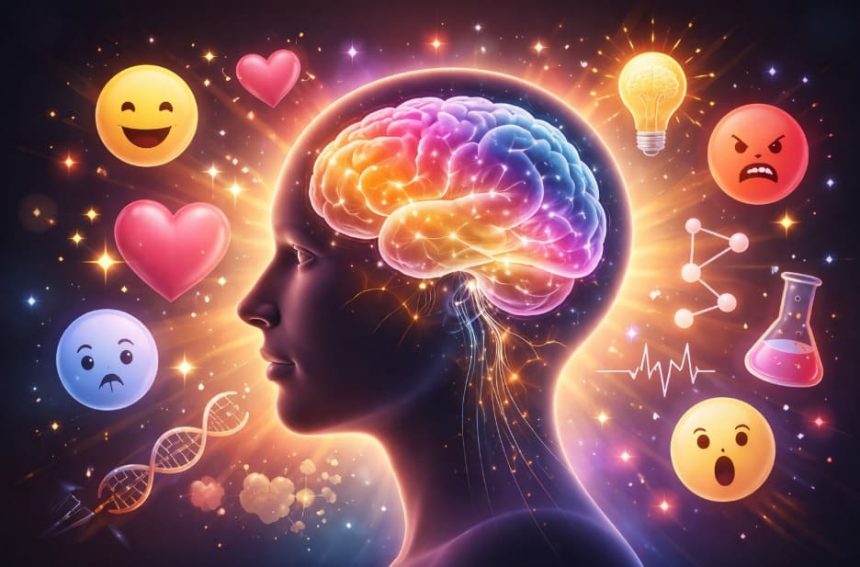
Human emotions are far more complex than simple feelings of happiness, sadness, anger, or fear. The way we experience emotions is deeply connected to brain chemistry, hormones, memory, and the nervous system. The phrase emotions explained by science helps us understand that every emotional response has a biological and psychological basis. From the release of dopamine during joy to cortisol during stress, science shows that emotions are not random—they are powerful signals designed to help us survive, connect, and make decisions. Understanding the science behind emotions can help us better manage our reactions, improve relationships, and gain deeper insight into human behavior.
1. Emotions Begin in the Brain Before You Fully Realize Them
One of the most fascinating scientific facts about emotions is that your brain often starts processing an emotional response before you become consciously aware of it. This happens because the brain constantly scans your environment and internal body signals for meaning. Structures such as the amygdala and prefrontal cortex help evaluate whether something feels safe, threatening, rewarding, or emotionally important. In many cases, your body may react first—such as a racing heart or sudden tension—before your conscious mind labels the feeling as fear, excitement, or stress. This is why emotions can sometimes feel automatic or instant. Modern neuroscience increasingly suggests that emotions are whole-brain events constructed from context, memory, and bodily sensations rather than simple one-button reactions.
2. Emotions Are Deeply Connected to Body Chemistry
Science shows that emotions are strongly influenced by neurotransmitters and hormones. Chemicals such as dopamine, serotonin, oxytocin, adrenaline, and cortisol all play major roles in how you feel. For example, dopamine is linked to reward and pleasure, cortisol is associated with stress, and oxytocin supports bonding and trust. However, emotions are not “just chemicals.” Instead, these chemicals act as messengers within larger neural networks that help create emotional experiences. The brain interprets signals from both the body and the environment to give those sensations meaning.
3. The Same Physical Sensation Can Create Different Emotions
A surprising scientific fact is that the same bodily sensation can be interpreted as completely different emotions depending on context. For example, a fast heartbeat could mean fear when walking alone at night, excitement before meeting someone you love, or nervousness before speaking in public. Science suggests that the brain uses surrounding context and past experiences to decide what the physical sensation means. This is one reason emotions can sometimes feel confusing.
4. Emotions Affect Memory Strongly
Science has shown that emotionally charged experiences are often remembered more vividly than neutral ones. This happens because the brain’s emotional centers interact closely with memory systems such as the hippocampus. Strong emotions like fear, joy, sadness, or love often make events feel more memorable because the brain marks them as important for future survival or learning. This is why many people can remember emotionally intense moments from years ago with remarkable clarity.
5. Negative Emotions Have an Important Survival Purpose
People often think negative emotions are bad, but science explains that emotions like fear, anger, and sadness serve important survival functions. Fear helps protect you from danger, anger can motivate boundary-setting and action, and sadness often encourages reflection and social support. These emotions evolved to help humans respond to threats, loss, and challenges more effectively. Rather than being harmful on their own, they become problematic mainly when chronic or unmanaged.
6. Emotions Are Felt Throughout the Entire Body
Emotions are not only mental experiences—they are physical experiences too. Science shows that emotional states affect heart rate, breathing, muscle tension, digestion, facial expressions, and hormone release. For example, anxiety may create chest tightness, love may create butterflies in the stomach, and sadness may feel like heaviness in the body. This mind-body connection is a core part of emotional science.
7. Your Past Experiences Shape Your Emotions
Scientific research strongly supports the idea that previous experiences influence how emotions are formed. The brain often uses memory and learned patterns to interpret current events. For example, two people may react very differently to the same situation because their past experiences teach their brains different emotional meanings. This helps explain why emotional responses are highly personal.
8. Emotions Can Influence Decision-Making
Science shows that emotions play a major role in decisions, often more than logic alone. Feelings such as fear, trust, excitement, or uncertainty can shape choices in relationships, finances, career moves, and daily life. Emotional processing helps the brain quickly assess risk and reward, which is why people often describe decisions as a “gut feeling.”
9. Mixed Emotions Are Scientifically Real
A surprising scientific fact is that humans can experience multiple emotions at the same time. For example, you may feel both happiness and sadness during a farewell moment or excitement and fear before a major life change. Neuroscience research increasingly supports that mixed emotions are real and can involve distinct neural activity rather than simply switching rapidly between feelings.
10. Emotions Are Influenced by Sleep and Stress
Science strongly connects sleep quality and chronic stress with emotional regulation. Poor sleep can make the brain more reactive, increasing irritability, anxiety, and emotional sensitivity. Chronic stress raises cortisol levels, which may intensify fear responses and reduce emotional resilience. This is why emotional balance often improves with proper rest, recovery, and stress management.
11. Emotions Spread Between People
Science shows that emotions can be socially contagious. Researchers often describe this as emotional contagion, where one person’s mood or emotional expression influences others nearby. For example, spending time with someone who is anxious can subtly increase your own tension, while being around a calm and joyful person may lift your mood. Facial expressions, tone of voice, posture, and even breathing patterns can unconsciously influence the emotional states of others. This helps explain why social environments strongly affect how we feel.
12. Your Brain Uses Past Experiences to Build Emotions
A major scientific insight is that emotions are strongly shaped by memory. Your brain compares what is happening right now with similar experiences from the past and then predicts what emotion best fits the moment. This is why two people can react very differently to the same event. One person may feel excitement, while another feels fear, based on previous experiences.
13. Fear Is One of the Fastest Emotions
Fear is designed for survival, so it is one of the fastest emotional responses in the human brain. The amygdala can rapidly process potential danger and trigger the body’s fight-or-flight response even before full conscious awareness occurs. This explains why you may jump back from something scary before you fully understand what it is.
14. Love Changes Brain Chemistry
Scientific studies show that love activates reward pathways in the brain, particularly those linked with dopamine and oxytocin. Dopamine contributes to pleasure and motivation, while oxytocin strengthens bonding and trust. This is why being around someone you deeply care about can create feelings of comfort, excitement, and emotional safety.
15. Stress Can Intensify Emotions
Chronic stress raises cortisol levels, which can make emotions feel stronger and harder to regulate. Under stress, people may become more reactive, anxious, or emotionally exhausted. Science suggests that long-term stress changes how the brain processes emotional signals, especially in areas linked with fear and decision-making.
16. Emotions Help the Brain Prioritize Attention
Emotions help determine what your brain pays attention to. Emotionally significant events often stand out more than neutral ones because the brain marks them as important. This is why emotionally intense moments tend to capture your full focus and remain memorable for longer.
17. Emotions Influence Physical Health
Science strongly supports the connection between emotional states and physical health. Long-term anxiety, sadness, or chronic stress can influence sleep, digestion, blood pressure, immunity, and overall energy levels. Positive emotions, on the other hand, are associated with improved resilience and recovery.
18. Happiness Is Not a Constant State
Scientific psychology explains that emotions naturally fluctuate. Happiness is not meant to be permanent because emotions are adaptive systems that respond to changing situations. Feeling a range of emotions is considered healthy and biologically normal.
19. Emotions Can Change in Seconds
Because emotions are constructed from rapidly changing body signals and context, they can shift extremely quickly. A single message, memory, sound, or thought can alter your emotional state within moments. This rapid flexibility is part of how the brain continuously updates your experience of the world.
20. Emotional Suppression Has Consequences
Science suggests that repeatedly suppressing emotions may increase internal stress and mental strain. While temporary control is sometimes useful, long-term emotional suppression can raise physiological stress responses and make emotional regulation more difficult later.
21. Positive Emotions Improve Recovery
Research suggests that positive emotions such as hope, joy, and gratitude can help the body recover from stress more efficiently. These emotions may reduce physiological arousal and support emotional resilience.
22. Emotions Influence Relationships
Science shows that emotional awareness and expression directly affect human bonding. Trust, empathy, love, and safety all rely on emotional communication. Healthy relationships often depend on the ability to recognize and respond to each other’s emotional states.
23. Sleep Directly Affects Emotional Control
Poor sleep can make the brain’s emotional centers more reactive while reducing rational regulation. This is why sleep deprivation often leads to irritability, mood swings, and emotional sensitivity.
24. Emotions Shape Behavior
From an evolutionary perspective, emotions guide behavior choices. Fear promotes protection, love encourages bonding, anger supports defense, and sadness may encourage reflection and support-seeking.
25. Music Can Trigger Powerful Emotions
Scientific studies show that sound and music strongly activate emotional processing areas in the brain. This is why certain songs can instantly bring joy, sadness, nostalgia, or excitement.
26. Emotions Can Affect Appetite
Stress, anxiety, and sadness often influence hunger signals and digestion. Some people eat more under stress, while others lose appetite completely. This is a strong example of the brain-body emotional connection.
27. Emotions Help Humans Survive Socially
Beyond physical survival, emotions support social survival. Empathy, guilt, affection, and compassion help humans cooperate, build trust, and maintain communities.
28. The Brain Predicts Emotions Before You Label Them
Your brain often constructs an emotional response before your conscious mind finds the words for it. This is why you may “feel something is wrong” before being able to explain it.
29. Emotional Awareness Can Be Learned
Science supports that emotional intelligence can improve with practice. Recognizing body sensations, naming feelings, and understanding triggers all help strengthen emotional regulation skills.
30. Emotions Are a Core Part of Being Human
Perhaps the most important scientific fact is that emotions are not weaknesses—they are essential biological systems that help humans survive, connect, decide, and grow. Emotions are deeply rooted in both the brain and body, making them one of the most fundamental parts of human life.