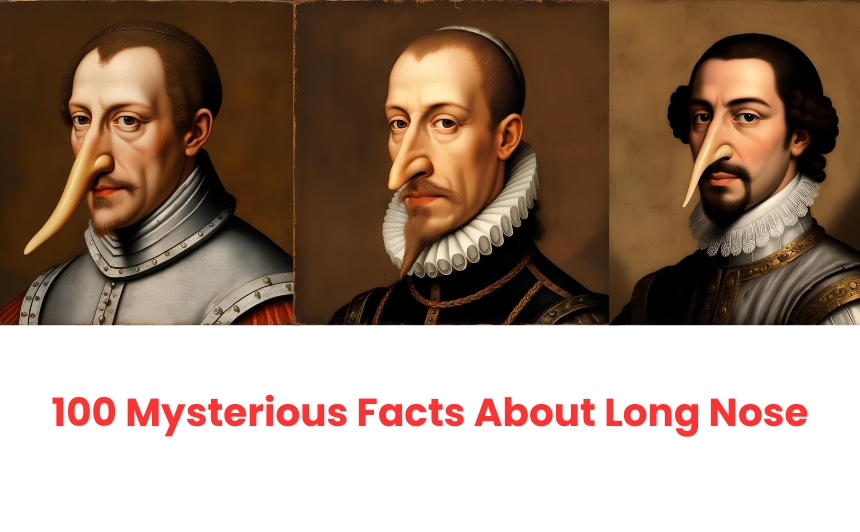
Throughout history, the mysterious facts about long nose have fascinated, confused, and even entertained cultures across continents. Noses—particularly long ones—have inspired legends, stereotypes, symbolic meanings, personality theories, and even entire art styles. In this blog, we explore 100 unbelievable, scientific, and strange, mysterious facts about long nose features and their role in human history, culture, and science.
🧬 Science & Anatomy
- A longer nose warms up inhaled air better in cold climates.
- Long noses help filter more dust and pollutants before air reaches the lungs.
- People with prominent nasal bridges often have stronger airflow channels.
- The length of your nose increases slightly as you age.
- Men statistically have longer noses than women.
- Nose size may be related to testosterone levels during puberty.
- Scientists believe nasal shape evolved depending on regional climates.
- Larger noses are sometimes found in people from colder or drier areas.
- The nose is made up of cartilage, which can elongate or droop with age.
- Long noses often provide stronger olfactory sensitivity.
🧠 Psychology & Personality Theories
- In face-reading (physiognomy), long noses are linked to intelligence.
- Ancient philosophers believed a long nose showed leadership potential.
- Some psychologists say a long nose indicates logical thinking.
- In Victorian England, long noses were associated with aristocracy.
- A long nose was once thought to mean someone is more honest—opposite of Pinocchio!
- Many fictional detectives are drawn with long noses to imply curiosity.
- In dating psychology, some think nose shape influences first impressions.
- A longer nose can create a more symmetrical face, which is seen as more attractive.
- Actors with long noses often get cast in authoritative or villainous roles.
- A long nose is often exaggerated in caricatures to emphasize uniqueness.
🌍 Cultural Beliefs & Superstitions
- In some African tribes, a long nose is seen as a sign of wisdom.
- Roman statues idealized long noses as noble and godlike.
- In Japan, the tengu demon has a long nose symbolizing pride and power.
- In India, a long nose in women was once linked to good fortune.
- Many Middle Eastern cultures associate long noses with wealth and fertility.
- In Chinese face-reading, long noses signify strong willpower.
- In Renaissance Italy, long noses appeared in portraiture of powerful families.
- Ancient Mayans intentionally shaped children’s noses to look longer.
- The term “nosy” likely originated from the idea of a long nose reaching into others’ business.
- The devil is often portrayed in art with an abnormally long or hooked nose.
🎭 Myth, Folklore & Fiction
- Pinocchio’s nose grew when he lied—popularizing the “long nose = liar” myth.
- Many witches in folklore are shown with long, crooked noses.
- Cyrano de Bergerac became famous for his romantic poetry and famously long nose.
- Elves in Norse myth often had pointed, elongated noses.
- Goblins and trolls in European stories usually have large noses.
- In Arabic folklore, wise jinn have long, straight noses.
- Hindu god Hanuman is often drawn with an extended face and nose.
- The nose of the Sphinx in Egypt was believed to have magical properties.
- Italian puppet shows often had long-nosed masks to depict comical characters.
- Shakespeare referenced long noses in relation to pride and wit.
🎨 Art, Media & Pop Culture
- Portraits from the 1500s emphasized long noses to show elegance.
- Surrealist artists like Dali exaggerated noses to explore identity.
- Many Disney villains (like Jafar) have long, narrow noses.
- Italian commedia dell’arte featured long-nosed masks for trickster roles.
- Cartoon characters use nose length to express different emotions.
- Hollywood often casts actors with strong nose profiles in serious roles.
- Famous artworks like “The Birth of Venus” depict long, elegant noses.
- Some anime characters are designed with longer noses to reflect authority.
- Editorial fashion models often have long, sharp nose bridges.
- Magazines have used photo editing to lengthen or shorten noses for beauty standards.
🧪 Bizarre, Weird & Fun Facts
- Some people get cosmetic surgery to lengthen their nose, not shorten it.
- Nose elongation can be done using wax prosthetics in theatre.
- Long noses have been fetishized in some niche art communities.
- World records exist for longest natural human nose.
- Certain masks in masquerade balls had comically long noses.
- In dream interpretation, a long nose can signify overreaching ambition.
- Some animals like anteaters have extremely long noses adapted for function.
- A long human nose can affect the pitch and resonance of your voice.
- Nose flutes are shaped to emphasize nose size in sound creation.
- Fake nose extensions are worn in some festivals as a sign of mischief.
💼 Business & Social Perception
- People with long noses are perceived as serious or disciplined.
- Studies show elongated noses make faces appear more intelligent.
- In some industries, prominent noses are considered a mark of distinction.
- In modeling, unique nose shapes create memorable facial features.
- Actors with long noses often get cast in “period dramas.”
- Some companies have banned caricatures that overemphasize long noses.
- Historically, noble families used nose shape in family crests.
- Some people seek rhinoplasty to keep a long nose intact.
- Unique noses are now embraced in inclusive beauty campaigns.
- An iconic look can be built around nose uniqueness in influencer culture.
🧘 Spiritual & Symbolic Meanings
- In chakra beliefs, the nose is connected to the third eye.
- Breath control through the nose affects mental clarity in meditation.
- A long nose is believed to “sense” spiritual energy in some traditions.
- Some shamans wear fake noses for ceremonial symbolism.
- In tarot illustrations, long-nosed figures represent watchfulness.
- Ancient Egyptian priests often wore elongated masks during rituals.
- Some spiritual symbols include an elongated face to show enlightenment.
- A long nose represents heightened intuition in metaphysical books.
- Yogic breathing emphasizes nasal awareness—longer noses allow deeper practice.
- In certain African spiritual ceremonies, long noses symbolize ancestral connection.
🐾 Nature & Animal Comparisons
- Elephants have the longest functional nose—called a trunk.
- Dogs with long snouts have stronger smell detection.
- Swordfish have long, nose-like extensions for defense.
- Baboons have exaggerated noses used for mating displays.
- Anteaters use their elongated noses for insect hunting.
- Horses have large nostrils but surprisingly flat nasal bones.
- Proboscis monkeys have famously long noses for vocal resonance.
- Star-nosed moles have strange elongated snouts to detect vibration.
- Dolphins have long rostrums that resemble noses.
- Hummingbirds’ “noses” are actually part of their long beaks adapted for nectar.
📚 Language & Expressions
- “Keep your nose out of it” means don’t interfere.
- “Look down your nose” implies arrogance.
- “Cutting off your nose to spite your face” refers to self-sabotage.
- “Nose for business” means someone is very intuitive.
- “Follow your nose” means trust your instinct.
- “Nosey parker” refers to a curious or prying person.
- “Nose out of joint” means someone is offended or upset.
- “Long-nosed” in some dialects means suspicious.
- The phrase “turning up one’s nose” refers to snobbery.
- A nose ring in some cultures protects against evil spirits.
🧾 Final Thoughts
These 100 mysterious facts about long nose prove there’s so much more than meets the eye—or nose. From cultural myths and scientific truths to artistic symbolism and modern psychology, the long nose carries layers of meaning that have evolved for centuries. Whether you love it, mock it, or simply admire it, it deserves its spotlight.